The future of cost-effective medicine?


An enterprising doctor in New York is offering a distinctive new form of treatment specializing in “young adults aged 18 to 40 without health insurance”. As well as making house calls to work or home, Jay Parkinson, MD will meet you online – via MSN, AIM, webcam or email – to discuss problems. Using the internet to search for the best price treatments to recommend also helps drive down the price of medicine. Are local surgeries and GPs under threat from the new world wide web docs? I can’t help thinking about the worlds of Snow Crash or Neuromancer when I think of doctors meeting you online to discuss your wounds.

[via Boing Boing, image from the doc’s website]
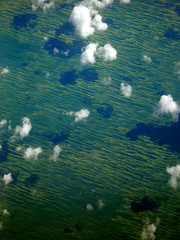
Want to use biofuel? There’s oceans of possibilities.

Could this green slime be a goldmine?

{image by Juvetson via Flickr Creative Commons}

A British biologist has suggested that there may be an overlooked candidate to make biodiesel. Corn, soy and Palm oil are three of the main crops converted into the alternative fuel but all have significant problems with environmental impact as well as raising the price of the foods themselves.

 John Munford proposed this week that much of the algae growing on the surface of the ocean could be harvested to produce biodiesel. Utah University has been studying fresh water algae, which can produce as much as 10,000 barrels of oil per acre. Munford says that seaborne algae has the advantage over this kind of pond scum by being self-maintained by existing ecosystems. An area similar to the North Sea could produce all the biodiesel currently used in transport across the world.

 [via The Economist]

A new use for satellite imagery: boosting sales!

Sample GeoPrism Data

New technologies have a tendency to develop unintended side effects, for both good or ill–just look at how automobiles changed society. Satellite imaging gave us better weather forecasts and more accurate military surveillance–and now, stronger sales leads for home contractors!

A company called Geosemble is using artificial intelligence combined with satellite imagery to direct companies toward local residents whose houses and grounds are in need of repair. The National Science Foundation in the U.S. has given them a Phase I grant to further develop the process.

Now if you’ll excuse me, I think I’ll go wrap my house in aluminum foil.

(Via Gizmag.)

(Photo from Gizmag, too.)

[tags]satellite, satellite imagery, privacy[/tags]

Podcasting for the next 10,000 years

podcast logoSo you really want to know how come I’m so informed about the challenges facing us in the future? How I can tell you what the ‘long tail’ is and why it works, when Bruce Sterling thinks the singularity will hit, or how I smell so darn good? Well folks, I’ll let you in on my little secret.

The Long Now Foundation is a group of people dedicated to fostering responsibility in humanity over the next 10,000 years. They go for the slow and better, rather than the faster and cheaper that we’re used to. There’s a section I came across called Seminars for Long-Term Thinking, that has roughly one speaker a month come and give a talk. Everything from long-tail sales of books via the internet to philanthropic investment over the next fifty years is covered. Between this and a few science/news podcasts, my daily commute has been covered for over a year. The seminars are available via iTunes or whatever your favorite podcasting program may be. Some of my favorites are Jared Diamond, Bruce Sterling (though I honestly didn’t get much of it – but it was fun!), and Robert Neuwirth. Subscribe to the podcasts, but also check out the website for slideshows and occasionally video presentations. Or, if you’re in the Bay area, attend the seminars.

Moore’s Law to end in fifteen years?

microchip Gordon Moore has predicted the expiry of the "Law" that bears his name to occur within the next ten to fifteen years. Moore’s Law is a rule of thumb that states that the number of transistors that can be inexpensively placed on an integrated circuit doubles every two years (or thereabouts), and it has held up remarkably well since Moore coined it in the mid-sixties.

Indeed, this isn’t the first time Moore has sounded a death-knell for the Law, but as conventional electronics is inherently limited by the laws of physics, it’s plausible that it has to stop at some point. So what does this mean for the exponential theories of Singularitarians like Ray Kurzweil? Or will technologies like quantum computing pick up the ball before semiconductors drop it? [Via SlashDot][Image by oskay]

[tags]Moore’s Law, computing, electronics, futurism[/tags]