Dutch prisons to close; not enough inmates

prison cell doorThe recession’s hurting all sorts of industries, it appears – the Dutch Justice Ministry has announced its intentions to close some prisons and slash 1,200 jobs, because there just aren’t enough criminals top fill the cells.

During the 1990s the Netherlands faced a shortage of prison cells, but a decline in crime has since led to overcapacity in the prison system. The country now has capacity for 14,000 prisoners but only 12,000 detainees.

Deputy justice minister Nebahat Albayrak announced on Tuesday that eight prisons will be closed, resulting in the loss of 1,200 jobs. Natural redundancy and other measures should prevent any forced lay-offs, the minister said.

The overcapacity is a result of the declining crime rate, which the ministry’s research department expects to continue for some time.

Apparently they’re considering importing detainees from Belgium in order to keep the jobs open… perhaps we’ll see more outsourcing of prison services in the years to come? Steal a car, see the world…

What differences in prisoner conditions might exist between countries with more incarceration than they can handle and those with space to spare? What underlying attitudes or legal frameworks are contributing to that lowering crime rate, and how might they manifest in the prison industry, if at all? [image by abardwell]

It’s also interesting to note that I’m currently sat in a country whose prison system is full to bursting and whose crime rate is allegedly spiralling, but the Netherlands is the country with the relaxed attitude to soft drugs like cannabis – isn’t that exactly the opposite of the way the legislators tell us these things should work?

Your new credit card, courtesy the US Treasury

There’s no shortage of weird and wonderful ideas flying around with regard to fixing the financial systems and making them fairer for the end users (i.e. most of us), but this is the first time I’ve heard this one crop up: state-backed interest-free transactional credit – or, in layman’s terms, a credit card issued by the government.

Access to revolving credit should be rationed, but transactional credit should indeed be ubiquitous. Not having to carry and count cash, deal with paper checks, or even worry about some particular account’s balance at the time of purchase are important benefits. Indeed, an efficient payments system is a public good. That’s why states are in the business of establishing currencies, right?

In fact, while transactional credit provision is a perfectly good business, it might be reasonable for the state to offer basic transactional credit as a public good. This would be very simple to do. Every adult would be offered a Treasury Express card, which would have, say, a $1000 limit. Balances would be payable in full monthly. The only penalty for nonpayment would be denial of access of further credit, both by the government and by private creditors. (Private creditors would be expected to inquire whether a person is in arrears on their public card when making credit decisions, but would not be permitted to obtain or retain historical information. Nonpayment of public advances would not constitute default, but the exercise of an explicit forbearance option in exchange for denial of further credit.) Unpaid balances would be forgiven automatically after a period of five years. No interest would ever be charged.

As is immediately pointed out in the resulting comment thread at MetaFilter, there’s a strong aroma of socialism around that idea which would prevent its adoption… not to mention the fierce anger of the credit card companies, should the idea be tabled seriously. But if there’s one thing we should have learned over the last few years, it’s that schemes which frighten the companies who make a killing by lending us money are well worth considering more closely.

Loopy space elevator concept

rotatingspaceelevatorsIn the same general theme as Keith Loftstrom’s launch loop concept [via Speaktomanagers] we have the Rotating Space Elevator:

Golubović and Knudsen have introduced the Rotating Space Elevator (RSE), a rotating system of a floppy string that forms an ellipse-like shape. Unlike the traditional Linear Space Elevator (LSE) made of a single straight cable at rest, the RSE rotates in a quasi-periodic state.

“The idea came by itself,” Golubović told PhysOrg.com. “I was thinking how to make things move easily and quickly up the traditional Tsiolkovsky-type space elevators. In my kitchen, I was mixing coffee in my cup too vigorously and the centrifugal force on the rotating coffee won over gravity to make some of the coffee lift and splash out the cup. This was my ‘eureka’ that lead to adding a similar conceptual feature to the old space elevator idea…

[via Next Big Future][image from Physorg]

The dystopians are out of step: humans are naturally optimistic

Democritus_by_Agostino_Carracci At least, that’s according to a new study from the University of Kansas and Gallup presented over the weekend at the annual convention of the Association for Psychological Science in San Francisco (via ScienceDaily):

Data from the Gallup World Poll drove the findings, with adults in more than 140 countries providing a representative sample of 95 percent of the world’s population. The sample included more than 150,000 adults.

Eighty-nine percent of individuals worldwide expect the next five years to be as good or better than their current life, and 95 percent of individuals expected their life in five years to be as good or better than their life was five years ago.

“These results provide compelling evidence that optimism is a universal phenomenon,” said Matthew Gallagher, a psychology doctoral candidate at the University of Kansas and lead researcher of the study.

At the country level, optimism is highest in Ireland, Brazil, Denmark, and New Zealand and lowest in Zimbabwe, Egypt, Haiti and Bulgaria. The United States ranks number 10 on the list of optimistic countries.

Demographic factors (age and household income) appear to have only modest effects on individual levels of optimism.

Now, has anyone actually conducted a scientific poll of science fiction writers to see how they stack up by comparison?

(Image: Democritus by Agostino Carracci, from Wikimedia Commons.)

[tags]public opinion, polling, optimism, dystopia, pessimism,psychology[/tags]

Map of science

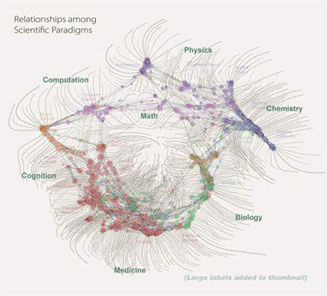
science_topic_mapSomething wonderful, not especially relevant to science fiction, but pretty and cool:

As to what the image depicts, it was constructed by sorting roughly 800,000 scientific papers into 776 different scientific paradigms (shown as red and blue circular nodes) based on how often the papers were cited together by authors of other papers.

Links (curved lines) were made between the paradigms that shared common members, then treated as rubber bands, holding similar paradigms closer to one another when a physical simulation forced them all apart: thus the layout derives directly from the data. Larger paradigms have more papers. Labels list common words unique to each paradigm.

It tickles my sensawunda node that we can now visualise our understanding of the physical universe in this way. Look at the map in close-up here.

You can see the great flowering coagulations of health, medicine, cell biology, and biochemistry. And brain research in the midst of a three-way tug-of-war between computer science, social science, and the study of the central nervous system (which is winning).

I wonder what this map will look like in a hundred years?

[image from Information Esthetics][via Eric Drexler]