


Personal Information is a new serial sci-fi webcomic from Sarah “Does Not Equal” Ennals.
Personal Information is a new serial sci-fi webcomic from Sarah “Does Not Equal” Ennals.
Thanks to regular reader Sarah Brand for the tip-off on this one; Tokyo-based entertainment company Kokoro has been uploading videos of Actroid F, their android actress, and they’re simultaneously impressive and creepy. Voila:
See what I mean? I’ve spoken to hotel desk staff and shop assistants less realistic than that! (Which probably says a lot about my shopping and travel habits; so it goes.)
[ Bonus aside for the rock fans in the readership, who may have noticed the album-name allusion in the title of this post: maybe the not-really-entirely-Kyuss-actually cash-in reformation could get an android stand-in for Josh Homme? I’d be more interested in catching the shows if they did, to be honest… ]
Shades of Eric Shmidt’s deniable childhoods in the news that the European Commission wants to enshrine the right of every citizen to be “forgotten” by the titans of the web, should they so choose. Take it away, Ars Technica:
As part of its newly outlined data protection reform strategy, the EU says it believes individuals have a “right to be forgotten.” That is, people should be able to give informed consent to every site or service that processes their data, and they should also have the right to ask for all of their data to be deleted. If companies don’t comply, the EU wants citizens to be able to sue.
“The protection of personal data is a fundamental right. We need clear and consistent data protection rules,” EU Justice Commissioner Viviane Reding said in a statement.
[…]
The new guidelines focus on more than just the right to be forgotten—the EU wants to cover most aspects of an individual’s personal data and how it can be used. For example, rules for how someone’s personal information can be used in a police or criminal justice setting will be changed, as well as how citizens can securely transfer their data to places outside the EU.
A laudable sentiment, but one which I rather suspect will be impossible to enforce in any realistic way. But hey, at least the right to sue will keep all those poor starving lawyers in work, right?
Offered for no other reason than that images like this still blow my mind in the same way that pictures from the Apollo missions blew my mind as a bookish seven-year-old protogeek: Nasa’s Deep Impact probe managed to get some photos of Comet Hartley 2 from just over 400 miles away [via MetaFilter].
![Comet Hartley 2 as seen by Deep Impact [image courtesy NASA]](https://futurismic.com/wp-content/uploads/2010/11/comet-hartley-2-deep-impact.jpg "Comet Hartley 2 as seen by Deep Impact [image courtesy NASA]")
The Universe == Awesome.
If you’d asked me what the twenty-tens would look like back in 1985, I don’t think I’d have said “1985”. But that’s the oroboros of culture for you, I guess; not only are the streets of big cities packed with preening hipsters dressed exactly like the alpaca-esque post-punks I used to be somewhat intimidated (yet subliminally inspired) by as they lurked moodily around the local war memorials, but Sir Clive Sinclair – the chap who gave his name to the ZX Spectrum computers that lurked in the corner of every second British kid’s bedroom around that time – is once again making a bid to populate the urban streets of Britain with what is in essence an electric-assisted bicycle in a plastic shell.
You’ve got to admire Sinclair’s classic British pluck, really; the C-5 remains an iconic example of duff eighties futurism, a gloriously eccentric failure and testament to well-meaning but ultimately misguided innovative engineering. The C-5 was ugly, fragile, and more than a little silly. So, has Sir Clive learned from the mistakes of the past?
The Sinclair C5, circa 1985:

The Sinclair X1, circa 2010:
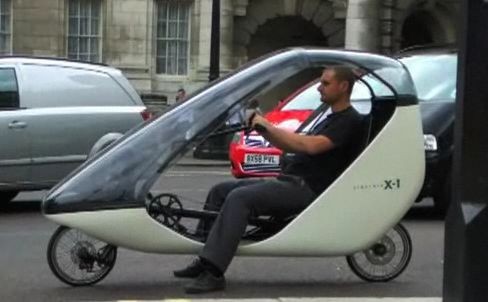
I’m going to go with “no”. Once more unto the breach, wot? Ours is not to reason why…
OK, I’m being a little over-snarky here, perhaps; I’m a big supporter of urban cycling and alternative transport, and I’d love to see the take-up on affordable and predominantly human-powered urban vehicles increase dramatically. But – and please forgive my cynicism – I don’t think that thing’s gonna do it. [images ganked from Gizmag]