Arboreal structures: tree benches, streetlamps

A splendid concept is being pursued to manipulate the roots of trees to create useful structures:

Pilot projects now underway in the United States, Australia and Israel include park benches for hospitals, playground structures, streetlamps and gates. “The approach is a new application of the well-known botanical phenomenon of aerial root development,” says Prof. Eshel. “Instead of using plant branches, this patented approach takes malleable roots and shapes them into useful objects for indoors and out.”

A company called Plantware is developing these, and similar methods, to create a wide variety of tree-based items. In addition researchers from Tel Aviv University are developing other environmentally friendly ideas:

Prof. Eshel’s team is also working on a number of other projects to save the planet’s resources. They are currently investigating a latex-producing shrub, Euphoria tirucalii, which can be grown easily in the desert, as a source for biofuel; they are also genetically engineering plant roots to ensure “more crop per drop,” an innovative approach to irrigation.
[story via Physorg]

Nostalgia does science fiction a disservice

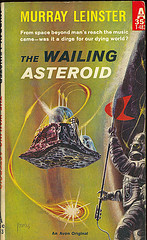
Old book jacket art for The Wailing Asteroid by Murray LeinsterNovelist Ian Sales makes an interesting point – a lot of the stories and novels held up as classics of the science fiction genre are actually very bad adverts for the modern form:

I’ve complained before about the undeserving admiration given to many science fiction novels and short stories of earlier decades. Such reverence frequently results in fans recommending these works to people wanting to try the genre. And that’s not a good thing. Readers new to the genre are not served well by recommendations to read Isaac Asimov, EE ‘Doc’ Smith, Robert Heinlein, or the like. Such fiction is no longer relevant, is often written with sensibilities offensive to modern readers, usually has painfully bad prose, and is mostly hard to find because it’s out of print. A better recommendation would be a current author – such as Richard Morgan, Alastair Reynolds, Iain M Banks, Ken MacLeod, Stephen Baxter, and so on.

I think Sales has a good point there. I came to science fiction through the authors publishing in the eighties, and as such I’ve found that a lot of the classics are, while interesting from a historical perspective, pretty unfulfilling reads. And hell knows being made to read some of Dickens’ more tedious works at school gave me a knee-jerk reaction to literary classics, too. [Murray Leinster cover scanned by J Levar]

Which authors would you recommend to a reader wanting to dip their toes into the genre, and why?

M.J. Engh to be honoured by SFWA as 2009 Author Emerita

We just got a press release from Jayme Lynn Blaschke of the SFWA:

Mary Jane Engh, author of Arslan and Wheel of the Winds among other works, will be honored as Author Emerita by the Science Fiction & Fantasy Writers of America for the 2009 Nebula Awards® Weekend in Los Angeles, California.

“Well, I hope ’emerita’ doesn’t mean ‘over the hill,’ but I’m truly honored — blown away, in fact,” Engh said. “It’s nice to know that somebody has noticed me.”

Under the pseudonym Jane Beauclerk, Engh published her first science fiction story, “We Serve the Star of Freedom,” in the July 1964 issue of the Magazine of Fantasy & Science Fiction. Over the next four decades, her short fiction appeared in a wide range of markets including Universe 1, Isaac Asimov’s Science Fiction Magazine and Arabesques.

Congratulations, Ms Engh! I’ll be entirely honest and say that I’ve never read anything she’s written, but I figure the SFWA don’t just give honours like that away for peanuts. If anyone knows where some of her fiction can be found on the web, do let us know, and we’ll stick the links up.

World of Warcraft trains your brain

World of Warcraft screenshotTired of specious and unsupported media claims that computer games are ruinous to the minds of children? Well, here’s the exact opposite – a number of studies discussed at the American Psychological Association convention demonstrate that computer games can actually develop problem-solving skills in younger players. [image by PhuSon]

Of course, that’s not really news to anyone from a generation that actually plays video games, rather than feeling intimidated by them. However, it does highlight the potential of games to be developed more deliberately as learning tools… but hey, let’s keep Orson Scott Card off the advisory committee, shall we?

[Tip of the horned battle helm to Guy Humphries via Darren “Orbit” Turpin]

Presenting the fact and fiction of tomorrow since 2001