Tag Archives: architecture

Oil-rig hotels could become Dubai on the high seas

If you found the recent post on seasteading a bit intriguing, but decided that either it looked too spartan for you or that you didn’t fancy turning your back on solid ground forever, you may be in luck. An LA-based architectural outfit has come up with a prize-winning design concept that sees decommissioned oil-rigs turned into luxury hotels, complete with prefabbed rooms that can be sailed out as a package the size of a standard shipping container.

oil-rig hotel conversion concept

As Morris Architects points out, the Gulf of Mexico alone has over 4,000 oil rigs that are destined for decommissioning over the next century – so why not make them into luxury resorts?

But as Geoff Manaugh of BLDGBLOG notes, that’s rather like the thinking behind Dubai… and look how that’s working out right now:

… if the real Dubai is any model for what might actually happen with such a resort, then we’ll probably see dozens of oil rigs partially converted to luxury hotels only then to be abandoned by their construction crews and investors. As the lands of southern Louisiana continue to disappear into the Gulf, heavily armed refugees on fishing boats will move out to sea, recolonizing the derelict structures. There will be campfires at night, burning driftwood, and speciality gardens.

4,000 of the things, just sat out there rusting away in the Gulf. You could get yourself an entire anarchic archipelago out of that little lot. [image borrowed from Morris Architects]

Shipping containers redux

Good grief, is there anything you can’t do with a shipping container? Hot on the heels of speculative mutating condominiums comes this: a nice simple urban newsagents:

A shop in a shipping container

Looks like it has been squeezed into a former front or side yard… this sort of instant architecture is likely to become a lot more commonplace in our cities, I feel.

Makes good business sense, too… locality becoming impoverished? Hire a truck, load her on and ship her out. A fully portable business. [picture by Paul McAuley]

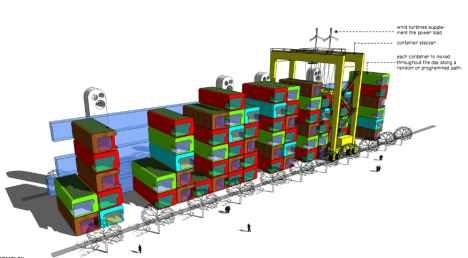
Corb v2.0 – mutating shipping container condos

The humble shipping container has been reimagined quite a few times in recent years, and has appeared as a potential housing solution in sf novels and stories from (among others) Ken MacLeod, Neal Stephenson and Gareth L Powell, as well as starring as a plot McGuffin in William Gibson’s latest; the BBC are even following a shipping container by GPS for a year.

But nothing quite prepares you for the bright day-glo architectural enthusiam of the guys who’ve come up with CORB v2.0, a kind of mutating condominium made from shipping containers:

CORB v2.0 shipping container condominium - image copyright Anderew Maynard Architects

Changing your view or neighbours with the seasons or on a whim is not a problem at Corb. Changes in family dynamics or space requirements are easily dealt with.

Traditional hierarchies determined and reinforced by wealth are void here. When you live at Corb, everyone gets a penthouse just as often as they get a ground floor apartment.

One can only hope that, unlike Hiro Protagonist, you don’t end up with a choice of views over the runways of a major airport… or, as seems more likely, over a busy freight port. [image borrowed from Maynard Architects site; all rights reserved by owner, reproduced here under Fair Use terms; story via Justin Pickard]

From bottles to bricks – recycling plastics into architecture

POLLI-brick - recycled plastic architectural componentOne of the less-feted stars of this year’s CES was the POLLI-Brick, an example of how recycling might be used to make something useful. The POLLI-Brick is an oddly-shaped plastic building block which…

… features a unique interlocking cylindrical shape and […] is created from around four recycled PET plastic bottles. The shape incorporates a great deal of air; thereby providing the thermal and sound insulation.

Besides their potential use as architectural components, they can be fitted with LED lamps in their cavities to provide mood lighting, or be used as plant pots. All good stuff, for sure – I’m all for reusing stuff we usually throw away -but one can’t help but feel that they’re going to look rather unfashionable rather fast, like last season’s rave club decor. Few things age as badly (and obviously) as architecture. [image borrowed from linked GizMag article]

And while we’re on the subject of recycling… oil prices may be low again at the moment, but they’re unlikely to stay that way forever. The prudent person plans ahead… so maybe you’d be interested in step-by-step instructions for converting your Honda Accord to run on organic trash, a bit like the Mr Fusion unit on the Back to the Future Dolorian? [via MetaFilter]

Shanty towns as architectural inspirations

Rio de Janeiro shantytownGOOD Magazine has a piece on architect Teddy Cruz, who plans to use the ad-hoc shanty towns of Tijuana, Mexico as the inspiration behind some new urban developments. The thinking is that what emerges out of necessity may actually have lessons to teach us about the efficient use of space and resources:

Behind the precariousness of low-income communities, says Cruz, there is a sophisticated social collaboration: People share resources, make use of every last scrap, and look out for each other.

[…]

Cruz’s plan aims to vault the income gap with developments on several lots that are integrated into the city. The developments will include 60 housing units, playgrounds, a market, urban agriculture, and job-training facilities, all managed by a coalition of nonprofit groups.

It’s certainly a nice idea, and I’d be the first to applaud any attempt to learn from emergent phenomena where human endeavour is concerned. But I can’t help but feel this might not work out quite as planned… possibly because the UK is littered with housing estates which were designed as self-contained communities, but which aren’t exactly examples of efficiency and harmony any more.

While there are surely lessons to be learned from shantytowns and other interstitial poor communities, I suspect the best lesson we can learn at present is that emergent systems are too complex to be copied easily. Necessity is the mother of invention, after all. [story via BoingBoing; image by Crucsou Barus]