Tag Archives: books

Weird…

Neal Stephenson’s new novel Anathem is to be published on the 9th September (according to Amazon). There is a kinda weird movie that claims to have something to do with the book (made by these folks apparently, though the movie is… vague and weird. I mean, it piqued my interest but I was probably going to buy the book anyway.

Even more compelling is the Amazon promotional video of Neal Stephenson himself reading an extract from the book. There is also a further video here of Stephenson discussing some of the ideas that go into the book:

Looks pretty good.

[via Slashdot]

Investigative journalism 2.0

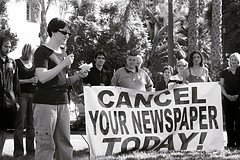
newspaper_journalismSelf-described new media whore Paul Carr has an interesting take on the future of investigative journalism and publishing – the problem:

Talk to a random sample of journalists and they’ll tell you the same thing – no one commissions investigative journalism any more.

Talk to any editor and they’ll tell you why; it costs a fortune to produce and rarely adds anything in terms of circulation or bottom line.

In an era of plummeting circulation and competition from free online news sources, as far as a cost-benefits analysis of newspaper investigations goes, it’s all cost and no benefit.

Basically another example of the problem of monetizing content that costs a lot to produce but little to reproduce. After dismissing one Web 2.0 business that attempts to address the problems of investigative journalism called Spot Us Mr Carr proffers his own solution:

I’d kill it. Take it out to the shed and put a bullet through its brain. Its been sick since the mid-80s and watching it try to struggle for twenty more years is embarrassing at best and cruel at worst.

Walk in to any bookshop and go to the politics, culture, biography or current affairs section. Now tell me investigative reporting is dead.

Of course these are the big stories – what of the smaller, more immediate ones? TV news. It’s there first, it has money and access and it has a 24 hour cycle to fill, meaning that every lead gets followed and reported no matter how apparently inconsequential.

Online news sources have their part to play too, although, frankly, they can be divided into two camps – brand extension for established media companies or total horseshit. Blogs have a role – but it’s confined to fact checking and uninformed gadflyery.

This gadfly likes Carr’s idea of idea of a cheap, subscription book-service, slightly more in-depth than a typical article in The Economist but less heavy than (for example) the 464 pages of Blackwater: The Rise of the World’s Most Powerful Mercenary Army and you would also get a tighter, more focused, and original piece of reporting:

I’d approach an established publishing house with a business plan – a new imprint that publishes short (40,000 words maybe), low cover price (£4.99 tops) books, each written by a recognised investigative reporter and each dealing with a single investigative subject.

Also recommended is Paul Carr’s recently published book Bringing Nothing to the Party: True Confessions of a New Media Whore. It combines hilarious gonzo journalism with genuine insight from Paul Carr’s experience as a wannabe Web 2.0 entrepreneur.

[story from Paul Carr’s blog][image from dsearls on flickr]

Ken MacLeod explains new novel The Night Sessions

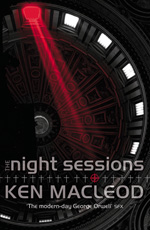
The Night Sessions by Ken MacLeodIf you’re looking for an intelligent contemporary science fiction novel that keeps focused on the near-future, you could do far worse than grab a copy of The Night Sessions, the new book from Ken MacLeod.

There’ll be a review here at Futurismic fairly soon, but in the meantime MacLeod‘s publishers Orbit have a brief blog post where he delivers the “elevator pitch” for The Night Sessions:

The Night Sessions is a crime novel set in 2037. It’s also an SF novel that asks the question: what if we finally got fed up with the influence of religion on politics, education, and law, and decided to drive it out of these areas for good?

They’ve also provided a hefty opening section of The Night Sessions as a free-to-read extract. Go read it, then come back and tell us what you think in the comments.

Pay attention, J K Rowling – fan-created content can work in your favour

J K Rowling might be interested to see that suing people who make derivative works based on your own creations isn’t necessarily the best option. YA author Stephanie Myers Meyer took the opposite approach by encouraging her fans to produce a Lexicon of her Twilight Vampire books, and as a result has engendered a hard core of people who evangelise the books on her behalf. [via TechDirt]

Word-of-mouth is the best form of marketing there is, so they say – and getting someone else to do the hard work for you seems like a smart move in a networked world. As I’ve mentioned before, I think the importance of fan-fic in building an author’s career is set to increase over time, and it is in author attitudes to fan-created works that we’ll start seeing the split between writers who have embraced the internet and those who cling to the old paradigms of print.

Bookworms have stronger people skills

The Bookworm I have occasionally wondered, as I write fiction, if what I am doing is really a particularly worthwhile way to spend my time. Shouldn’t I be off actually, you know, building something? Inventing something? Saving the planet?

Via Blogowych, I am encouraged to learn from Toronto’s Globe and Mail that:

A group of Toronto researchers have compiled a body of evidence showing that bookworms have exceptionally strong people skills.

Their years of research – summed up in the current issue of New Scientist magazine – has shown readers of narrative fiction scored higher on tests of empathy and social acumen than those who read non-fiction texts. And follow-up research showed that reading fiction may help fine-tune these skills: People assigned to read a New Yorker short story did better on social reasoning tests than those who read an essay from the same magazine.

Those benefits, researchers say, may be because fiction acts as a type of simulator. Reading about make-believe people having make-believe adventures or whirlwind romances may actually help people navigate those trials in real life.

And, yes, science fiction gets mentioned, although in that usual sort of “ooh, how icky” tone one encounters so often in news stories:

And do sci-fi tales about chasing aliens through the galaxy have the same benefits as Alice Munro’s short stories about love and loss?

This is a false dichotomy, of course. A story about chasing aliens through the galaxy can as easily be about love and loss as a story set in the here-and-now.

Besides, I’d argue that if one of the benefits of mundane fiction is that it acts as a “type of simulator” of real life, then one of the benefits of science fiction (oddly enough, maybe even in particular so-called Mundane SF) is that it acts as a type of simulator of how life may be affected by the never-ending and accelerating onslaught of the effects of technological change. So even if science fiction fans may not necessarily have exceptionally strong people skills (and certainly I’ve met a few at conventions who most emphatically did not), they may just possibly have exceptionally strong skills in other important areas, like adjusting to cultural upheavals and dealing with new technology.

And also exceptionally strong alien-chasing skills, of course. You never know when those might come in handy.

(Image: The Bookworm by Carl Spitzweg.)

[tags]books, science fiction, reading, psychology[/tags]