Tag Archives: books

My book is out, and I’m giving it away–the sequel!

Terra Insegura resized Paul recently accused me of being too modest to promote myself here on Futurismic, but this should prove him wrong!

My latest science fiction novel, Terra Insegura, is out from DAW Books tomorrow, and to promote it, I’m running a month-long giveaway at my blog (details here). You’re welcome to enter over there, but as I did last year for Marseguro, I’m also offering a special for Futurismic readers only.

Email me at edward(at)edwardwillett.com and put “Futurismic contest” in the subject line, and I’ll enter you in a Futurismic-only draw. The first name drawn receives a copy of Terra Insegura, and the second name drawn a copy of last year’s Aurora Award-nominated Marseguro. (I’ll only ask for mailing information from the winners after they win, and don’t worry: I’ll ship anywhere in the world.)

I’ll keep this draw open for two weeks, closing it at midnight GMT on Sunday, May 17.

And just a reminder: you can read the first two chapters of the book and/or listen to me read them on my website.

We now return you to your regular Futurismic programming.

(Image: Cover art by Stephan Martiniere.)

[tags]Edward Willett,science fiction, books, novels, contests[/tags]

On the grazing habits of the post-scarcity culture vulture

stacks of booksIn a world so full of entertainment choices that you could probably spend your entire life reading or listening or watching without ever having to repeat yourself, how do you choose what to enjoy next?
Favouring a single genre is one solution, of course, but even that’s a bit tricky nowadays, as pointed out by Jon Evans over at Tor.com. Just reading every science fiction novel published in a year would be quite a challenge if you wanted to hold down a job at the same time.

Evans thinks he’s identified two major coping strategies in our world of entertainment post-scarcity:

In my highly anecdotal experience, people tend to react to this overwhelming cornucopia in one of two ways: either they swear allegiance to one particular subfragment of genre, and deliberately steer clear of all else, or they try to sample a little bit of everything. I call this the buffet effect.

I used to be a specialist. Now I’m a sampler. Fifteen years ago, I felt like I had read most, if not all, of the good SF that had ever been published. Nowadays, I’m not sure that’s even possible; specialists have to focus on smaller subgenres, such as horror, or cyberpunk, or military SF.

As a sampler, I find myself reading one or two of an author’s books—and then moving on. I have read and really liked two Charles Stross novels, for instance, which once upon a time would have meant devouring everything he’s ever written. Instead I’ll have to overcome a certain reluctance to buy another book of his. I want to read them all, don’t get me wrong; but at the same time, I find myself subconsciously thinking of the “Charles Stross” box as already ticked, and wanting instead to try a brand-new dish from the endless buffet.

Interesting; I find myself kind of caught between the two states, personally, in that I go through brief periods of specialisation until I get distracted or derailed by some shiney new discovery, be it an author or style or subgenre; getting a commission to review a new title can provide an unexpected change of direction, too. [image by ginnerobot]

What about you – how do you decide what’s next in your to-be-read (or to-be-watched or listened-to) piles?

DIY industrial-grade book scanner made from junk

Have you ever fancied playing Google for the afternoon? How about starting your own book-scanning project?

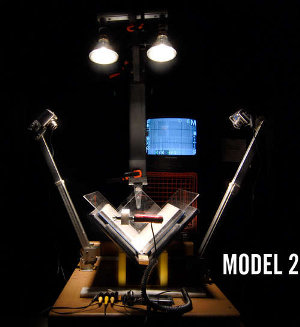
If you’re thinking that’s too far out of your price-range, think again – as an entry to a contest on Instructables, a chap called Daniel Reetz built his own automated book scanner, predominantly using stuff he found in dumpsters alongside some cheap digital cameras.

Reetz's Model 2 book-scanner

OK, so even if you could get the parts, the techniques might be a bit beyond the reach of those of us who struggle to change a bicycle tyre… but that’s a pretty impressive display of resourcefulness and ingenuity on Reetz’s part. I wonder if he’ll let me borrow it in exchange for scanned copies of every book I own? [via Hack-A-Day]

ISBNdb – it’s IMDB for books

Heads up, academics and A-grade book geeks – here’s a site you’ll want to be adding to your bookmarks for research purposes. ISBNdb, as its name suggests, attempts to do for books what IMDB does for movies. From the FAQ page:

ISBNdb.com gets the data in a unique way – it scans libraries all across the world for book information. The scanning is random and similar in a way to how general purpose web search engines scan web sites.

Scanned results are then parsed and stored in a searcheable and browseable database that you see here on ISBNdb.com. An attempt is made at cross-indexing the database by author, publisher, category and so on. Cross indexing is still a work in progress and is likely to improve as the time goes on.

For each book you can see records received for it from different libraries, you can download original MARC record for the book as it was returned by the library.

Another interesting feature is ‘Books on the Same Shelf’ — it allows to quickly look up similar books in the same way they would be placed in a real world library. Currently, two classification systems are supported — Dewey Decimal Classification (trademark of OCLC) and Library of Congress Classification.

Starting late 2004 we also started scanning book merchants for best book prices. You will see best prices for new and used copies on all book pages below the left menu in most cases fraction of a second after you load the book data. Active and historic prices are also available through the data access API.

I just lost half an hour of productivity to that thing without even trying! And that API is just begging someone to do some good mash-up work; it’s the sort of thing author- or genre-specific fan sites could get some great mileage from.

My inner bibliophiliac library employee needs to go lie down in a dark room right now… [via GalleyCat]

Why ebooks must fail

book spine bindingYou may have seen this already, but just in case: Evan Schnittman is head of global business development at the Oxford University Press, and he sure knows how to make the first post on a new blog punch hard. In his inaugural piece, he explains why the success of consumer ebooks would collapse the publishing “Ponzi scheme”.

I’d advise reading the whole thing for a very honest warts-and-all explanation of the economics involved, but the money-shot is right at the end:

And therein lies the dilemma… how does the publishing industry fund the creation, editing, design, production, marketing, e-warehousing, and sales of ebooks, if the income isn’t there? How do ebooks cover the huge advances needed to buy books if we cannot generate the cash, especially at their extremely low, discounted prices, cover the advances that an entire industry has come to require? The answer is that ebooks, alone, cannot.

What this means is that unless a very different model evolves, ebooks can never become the dominant version of content sold by book publishers. It means that ebooks will always be priced to sell, but sold as an afterthought, not as the primary version of a work. It means that the need for blended e plus p models will evolve, in order to take advantage of all the great qualities of ebooks, while providing the financial support and structure that print offers. It means that consumer ebooks, as a stand-alone version of an intellectual property, must fail.

Of course, it’s not an utterly bleak prognosis; Schnittman promises to follow up with a series of business models that will explore the factors he describes, including one that he believes will let the publishers have their cake and eat it, and I know I’ll be looking forward to reading them. It’s good to find someone close to the core of the industry who isn’t beating around the ebook bush. [via GalleyCat; image by smellyknee]