Tag Archives: books

Self-publish and be damned? The modern writer’s dilemma

Damien G Walter has been thinking about self-publishing, reassessing the established wisdom that self-publication is de facto a bad thing.

To date, self publishing has been a bad idea. People without the necessary skills and experience full prey to vanity publishers. Writers with some talent but who are still learning can expose their work too soon. Excellent writing can find itself swamped among the dross that is self published every year and no one bothers to go looking for it. The general wisdom on self publishing for anyone who aspires to become a professional author has been… don’t.

Walter goes on to point out that the landscape has changed somewhat in recent years, with rising stars such as John Scalzi and Kelly Link owing some portion of their success to self-publication of one stripe or another, and with the publishing industry suffering at the hands of market forces.

The main argument against self-publication is that it usually results in work that will harm the author’s reputation: rip-off vanity press jobs, or simply work that isn’t ready for publication which would have benefited from more revision and/or editorial input. These problems apply more to the beginning author, though; the point has been made before that an author with the stature of Stephen King could probably self-publish with a great deal of success (not to mention a bigger profit margin). But the principle appeal of self-publishing for a new author with genuine skill is the opportunity to start building an audience and having readers engage with the work… and that’s not so easy a benefit to dismiss.

Walter concludes:

If the general wisdom about self publishing has been ‘don’t’, its likely that wisdom may change to ‘do – but with great caution’. There has always been a role for self publishing, but as that role grows, the provisos that accompany self publishing will grow all the more important. Authors will need to be aware that self publishing means more than just having a book printed. It means being an editor, a distributor and a marketer of your own work. It means investing in yourself in exactly the way a good publisher invests in their authors, whilst taking the risks a good publisher also takes. It means understanding the arc of your own career as a writer in the same depth that good editors and agents do. And most of all it means having an honest and accurate understanding of the quality of your own writing, maybe the hardest thing of all.

For most self publishing will continue to be a mistake, but for writers with enough talent and determination it is already becoming an important part of building a readership, one that for many writers it will be a mistake to simply dismiss.

For what it’s worth, my work as a music reviewer has exposed me to a similar evolution in the music business; it’s easier than it has ever been for a band or soloist to record their work and make it available to anyone. As with writing, many of them jump the gun and release before their work is up to a standard where it can survive against product recorded and promoted by the established labels… but there are the occasional success stories, be they out-of-nowhere newcomers or established acts turning their backs on an exploitative  system.

This contrasts with our recent post on comics self-publishing, where Jim Munroe pointed out that the stigma against self-published works in the comics field is minimal by comparison to the literary field, and suggests that it may be because it’s easier to discern the quality of comics ‘at a glance’.

Will we see a change in attitude toward self-publishing in years to come? I think it’s inevitable, though it will take time… and the sheer mass of terrible self-published work (much of which Futurismic receives email about on a daily basis, I might add) will do much to slow it.

But economics may provide an accelerating force; all bets are off on how things will look in five years’ time. So, writers in the audience – published or otherwise – have you self-published, or considered doing so? And what factors influenced your decision?
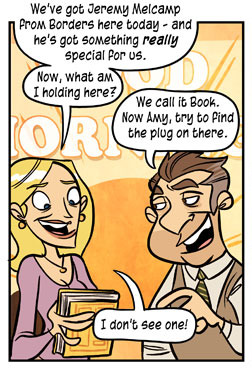
Progress – the ebooks debate rumbles on

Progress - Penny Arcade on ebooksI suppose I shouldn’t be, but I can’t help feeling surprised at how widespread the debate about ebooks is becoming – I honestly didn’t expect so many people would care so soon. Penny Arcade‘s take is unsurprisingly snarky [see right], but also somewhat conservative given their games’n’gadgets leanings (even allowing for comic license).

The best thing about the breadth of the discussion is that we’re getting a whole lot of different perspectives beyond authors and book-nerds. For example, The Big Money gives us the business logistics guy’s view, namely that “[d]igital readers will save writers and publishing, even if they destroy the book business”:

Here’s where the Kindle comes in. The collapse of bookstores almost ensures that the Kindle will thrive. Not because it’s better than a book; that doesn’t matter. The nation-within-a-nation that reads for pleasure and to be informed is a small but vibrant republic. Heavy readers make up a large portion of the book-buying public. These are people who read two to three books a week and buy 50 or so books a year. The Kindle will solve a number of problems for the citizens of Biblandia, not the least of which is having to go find a bookstore to get their next read.

Elsewhere, uber-PR guy and social media pundit Steve Rubel sees the Kindle and its ilk as “the last Great White Hope” for monetizing text media like journalism:

The Kindle, like the iPod, is an emerging critical mass device that actually encourages people to pay for content rather than get it for free. When Apple launched the iTunes Music Store, people were skeptical that people would shell out cash for music they could snag for free from file sharing networks. They did. The same was true when Apple, and later others, rolled out movies. However, today millions rent or buy movies online.

The Kindle offers a similar experience in a much larger market – text. This one is tougher to monetize. In the digital age books have managed to remain premium content. However, beyond books, magazine and newspaper content is available in abundance online for free. Yet, I still believe that people will pay to receive some of their favorites on their Kindles or their Kindle-enabled phones. Meet them there now while you can.

And of course, there’s the segment of the publishing industry that has gotten itself beyond denial and/or arm-flapping to the point of grappling with the potential that’s sat on their doorstep. Rather than dismissing ereaders as imperfect implementations, the Pan Macmillan digital team are looking ahead to what they see as an inevitable “iPod moment” for text:

… the iPod had a phenomenally intuitive control, especially given the bemusing buttons and rollers of it’s competitors (and I should know as I held out for some time, before caving in with a combination of resignation and glee). Characteristic of it’s manufacturer this no doubt has been an enormous boon to the device. Beyond that though the now iconic look from legendary Apple designer Jonathan Ive was what made us want one. The iPod wasn’t just useful, fun etc- it was jaw grindingly desirable.

Usability and covetability. Two principles for world domination.

What strikes me as being the interesting parallel with these two, aside from the the slightly obvious observations just outlined, is that both came from behind. They did not have first mover advantage. Instead they used these design concepts to leapfrog into pole. Indeed, it could be argued that precisely not coming first was an advantage in that it allowed the pair to fine tune their product and get these two crucial areas right.

Going back to the ereader then, I get the sense that we are on the cusp of when useability and covetability collide, uniting in a glorious burst of reading device nirvana. Ok maybe not quite, but once those user interfaces have been tweaked, and once someone like Ive gets there hands on a reading device, they will be back.

So we’re not quite at the “all bets are off” stage, but we’re certainly beyond the point where it’s a few evangelists with sandwich-boards prophesying the end-times. The more I look at it, the more I suspect that with ebooks the question is no longer “if?” but “when?”

What about you lot – how many of you have a reader already, and how has it changed your text media consumption? And for those that don’t have one, what will be the change that makes you cross the line?

Slow down, you read too fast…

mosiac of a man reading a book… you’ve got to make the moment last. Or so says Ian McDonald over at the Pyr blog, confessing that he’s a slow reader and proud of it:

What interests me here is not so much the dwindling of attention spans, as what I call ‘nuggeting’ – scanning only for the important points, the catching points where the eye and the brain latch on to information – a point of change or transition or a contrast. Nugget to nugget, getting the eye-kicks in at the required bpm. I wonder if that’s what the commentariat mean when they say ‘the storyline did not engage me’ –the nuggets, the changes, the beats didn’t come fast enough. I think it’s a sad and bad thing. If we’re exposed to only what stimulates, it deadens the response. Reading isn’t only about finding out what happens next. Why hurry to the end? Take your time. There’s plenty to enjoy on the way.

I half-agree with McDonald here – certain books demand to be read more slowly, either because they are richer in ‘nuggets’ or because the prose itself is satisfying to linger over (or because they’re not written very well, though I tend to give up on bad books these days, as life’s too short already).

But equally there are books that demand to be read quickly, and are all the more fun for that. And most of all, I think there are big risks in making general statements about how and why people should read for pleasure; McDonald naturally has a creator’s concern about his work being appreciated as he intended it, but I know I’d be a resentful of being told how I should best enjoy a book by anything other than the book itself. [via SF Signal; image by takomabibelot]

What about you – is it fast-moving page-turners that you’re after, or do you prefer books that you can lose yourself in for a week or two?

Google to publishing: OM NOM NOM NOM

Google cookieRichard Sarnoff of the American Association of Publishers has been speculating about that organisation’s tabled deal with Google over its Book Search facility, and according to Ars Technica he claims the deal forces Google into direct competition with Amazon’s business model:

Sarnoff said the publishers he represents didn’t set out to create a monopoly in the markets for book search engines or online book sales. But he didn’t deny that the settlement could have that effect. After all, he noted, “copyright itself is a monopoly.”

It’s not often you hear that from someone on the publishing side of the equation. But it’s so far hard to tell who has actually got the better end of the deal:

Sarnoff outlined the terms of the settlement, which is expected to be approved by the courts later this year. It reads like a blueprint for the future of electronic book publishing, covering topics as wide-ranging as advertising, library access, and the treatment of orphan works. A key element of the agreement is the creation of a Book Rights Registry that will collect payments from Google and distribute them to authors and publishers. Sarnoff said the publishers pressed for the creation of this registry in part because it would be too “easy to disintermediate the publisher over time” if Google paid authors directly. Sarnoff said that the structure of the registry will be “tough to replicate for [Google’s] competitors.”

Only time will tell whether the AAP has taken the enemy to bed. But it’s grist for the mills of those who worry that Google is already too big for its boots – another discussion point where the word ‘monopoly’ tends to crop up with frequency, and one that varies in tone from polite concern to foaming-at-the-mouth paranoia and conspiracy theory.

What do think – will we be consumed by the silicon Rapture on the day Google finally crawls the DNA of each and every one of us? Or are they just a company who brought out the right business model at the right time?

I’m not that worried; from the looks of things, if Google does end up as a digital despot, at least I’ll have plenty of things to read… [image by massless]

Doctorow on the decline and fall of novels

man reading a novelThe ever-ubiquitous Cory Doctorow crops up over at Internet Evolution, talking about “media-morphosis” – the ways in which the internet is mangling and mutating all the other forms of media. The whole thing is worth a read, but I thought I’d pick out a bit of Doctorow’s thinking about the future of the novel, as it fits quite neatly with some of the recent ebook posts here at Futurismic. [image by John Althouse Cohen]

Doctorow points out that books are suffering on two sides – firstly from the rise of the big-box retailers, which have restricted the titles available, and secondly from the way we’re being conditioned by the web (and other media imitating the web) to read in short, easy-to-swallow chunks – and then paints a worst-case scenario:

If big-budget movies might turn into opera, then long-form narrative books might turn into poetry. There’s a hell of a lot of published poetry — more than ever — mostly consumed by other poets and a small band of extremely dedicated followers of the form. A few poets make a big living at it, a few more make a marginal living at it, but for most poets, income is aspirational, not reality-based (this is pretty close to the situation in short fiction already, and not far off from the world of novel writing in many genres).

But a future in which novels turn into hand-crafted fetish items for a small group of literati is one in which the relevance of the novel dwindles away to a dribbly nothing.

I think most of us here would see that as a rather sad omega point for one of our favourite media, especially given the incredible artistic possibility it has to offer; Doctorow suggests that one route to salvation for the novel would be to build the sort of evangelical business that distributes books to places that they otherwise might not reach.

But what if his worst-case is actually the fact of the matter? Is it not possible that the novel will increasingly become an anachronism, the sort of thing considered historically interesting but culturally irrelevant by 21st Century humankind? Maybe we just need to face up to the idea that reading books for fun is a pastime whose days in the sun are over, no matter how personally attached to it we may be.