Tag Archives: climate-change

Climate change forces Maldives to attempt buying a new homeland

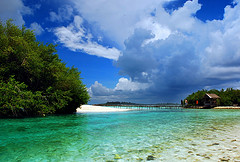
Maldives beachAll the arguments about what actually causes global warming look pretty pointless when you read a story like this one: the Maldive Islands – the highest point of which is a mere 2.4 meters above sea level – are planning to divert tourism income into a fund with which to buy a new homeland elsewhere. [image by notsogoodphotography]

[President Nasheed] said Sri Lanka and India were targets because they had similar cultures, cuisines and climates. Australia was also being considered because of the amount of unoccupied land available.

“We do not want to leave the Maldives, but we also do not want to be climate refugees living in tents for decades,” he said.

[snip]

Nasheed said he intended to create a “sovereign wealth fund” from the dollars generated by “importing tourists”, in the way that Arab states have done by “exporting oil”. “Kuwait might invest in companies; we will invest in land.”

Yet another straw on the camel’s back of geographically-defined nation states? You can bitch about the causes all you want, but when people’s homes start to disappear beneath the sea they’re not going to pay a damned bit of notice to you fiddling while Rome burns.

Climate change all over the place

And speaking of climate change there is an interesting story at the BBC about how monsoons/droughts, as recorded in the concentrations of minerals in stalactites, have been linked with Chinese dynasties:

By comparing the rain record with Chinese historical records, Pingzhong Zhang of Lanzhou University in China, and colleagues, found three out of five “multi-century” dynasties – the Tang, the Yuan and the Ming – ended after several decades of weaker summer monsoons with drier conditions.

These moisture-laden winds bring rain necessary for cultivating rice. But when the monsoon is weak, the rains stall farther south and east, depriving northern and western parts of China of summer rains.

This could have led to poor rice harvests and civil unrest, the researchers speculate.

It’s an interesting theory, and reflects how important climate is in the lives of humanity, and also in the lives of lemmings, with the discovery that the lemming population of Norway is no longer as fecund as it once was:

The research team, composed of Norwegian and French scientists, believes the winters are now too humid, leading to the “wrong kind of snow“.

This results in a less stable subnivean space (the space between the ground and the snow layer above), meaning substantially fewer animals survive until spring.

Aww. But apparently it’s not all bad news vis a vis climate change. Apparently certain Alaskan glaciers have in fact grown this year for the first time in 200 years.

This will please Sarah Palin – who apparently has only recently discovered that Africa is a continent, not a country.

Congrats on the win, America!

As to the glaciers – only time will tell.

[wanxiang cave image from BBC News, lemming from kdleditsch on flickr]

Ken MacLeod on the New Enlightenment

Quite old, but still relevant, here is an exerpt from a brief comment by author Ken MacLeod on the “new enlightenment” and the divisive debate surrounding global warming and environmentalism:

In science fiction, the key challenge is thinking about questions of the future. Some of the tools we have for thinking are broken or blunted. The climate change issue is a good example.

It’s difficult for the informed lay person even to decide if there’s a problem or not. The difficulty lies not in the complexity of the science, but in the subversion of the institutions of science, communication and democracy.

The role of the interest groups involved, whether it’s the energy corporations or the environmental campaigners, has been to accuse the other side of doing what the other side accuses them of doing – namely, subversion.

MacLeod may not be a climatologist but he makes a good point about the basic nature of the argument.

[image from geraintwn on flickr]

Climate change steps on the gas

melting Arctic iceHoooooo-boy. Just in case global financial disasters and geopolitical instabilities haven’t given you enough things to worry about, here’s a another: remember when scientists suggested that melting ice-caps at the poles of the planet could end up releasing massive reservoirs of sub-oceanic methane into the atmosphere, amplifying the greenhouse effect and accelerating climate change to an even greater degree?

Turns out that we’re finding more evidence for that theory than anyone really wants to find. Anyone wanna buy us out of this little problem? [via WorldChanging; image from linked Independent article]

Is Peak Oil a lie?

Alaskan oil pipeline at PaxsonI’m going to shamelessly crib from io9 and link to the Cleantech Group’s write-up of a talk by an environmental futurist named Peter Schwartz, because he has a pretty provocative point to make. In a nutshell – Peak Oil is a lie, and it’s a lie that could make things worse rather than better.

Peak oil is wrong. We really don’t know how much oil there is in most of the oil reservoirs of the world. Oil reservoirs are complex geological structures, and most of the data is in private hands, or in state governments, and they are not particularly forthcoming about how much is there.

However, he’s far from denying that climate change is a problem:

We are not going to run out of oil before the issue of climate change drives change. It’ll be costly oil. But it’ll be climate change catastrophes [such as sudden, unexpected displacement of large numbers of people, and massive property damage], and more expensive oil, not the fact that we’re running out of oil, that will drive change

Of course, Schwartz is just one man, and an awful lot of people seem to be pretty convinced that Peak Oil is real, so I can’t argue that either way because I don’t have the knowledge or evidence to do so. But it’s interesting (and refreshing) to hear someone deny Peak Oil without denying climate change at the same time. [image by Steve Deger]