
Tag Archives: computer

The Changing Face of the American Apocalypse: Modern Warfare and Bad Company

Blasphemous Geometries by Jonathan McCalmont

###

“Welcome to the Desert of The Real” announces Laurence Fishburne’s Morpheus as he introduces The Matrix’s (1999) Neo to images of the charred remains of what was once human civilisation. A civilisation that has since been digitised and placed online while the real world crumbles beneath an ash grey sky. Morpheus’ drily ironic line would later be re-invented by the Slovenian philosopher and psychoanalyst Slavoj Žižek in an essay prompted by the September 11th attack upon the World Trade Center. Žižek’s point is a simple one : The 9/11 attacks destroyed not only some buildings, but also America’s conception of what the real world was really like. Since the end of the Cold War, the West had fallen into a cocoon of smugness created by the comforting belief that, with the collapse of the Soviet Union, all opposition to liberal democracy had simply dried up and blown away; that, as the Berlin Wall came down, Humanity found itself united in the same set of desires for elected governments, human rights and consumer goods – desires for the kind of things that the American people had. It was, as Francis Fukuyama put it, The End of History. Continue reading The Changing Face of the American Apocalypse: Modern Warfare and Bad Company
Self-assembling silicon circuits

Photolithography is running up against its limitations, as logic circuits become so small that the wavelength of light itself is too large to mask the patterns accurately. MIT boffins reckon they have a solution, though: self-assembling semiconductor circuits [via NextBigFuture].

Berggren and Ross’ approach is to use electron-beam lithography sparingly, to create patterns of tiny posts on a silicon chip. They then deposit specially designed polymers — molecules in which smaller, repeating molecular units are linked into long chains — on the chip. The polymers spontaneously hitch up to the posts and arrange themselves into useful patterns.

The trick is that the polymers are “copolymers,” meaning they’re made of two different types of polymer. Berggren compares a copolymer molecule to the characters played by Robert De Niro and Charles Grodin in the movie Midnight Run, a bounty hunter and a white-collar criminal who are handcuffed together but can’t stand each other. Ross prefers a homelier analogy: “You can think of it like a piece of spaghetti joined to a piece of tagliatelle,” she says. “These two chains don’t like to mix. So given the choice, all the spaghetti ends would go here, and all the tagliatelle ends would go there, but they can’t, because they’re joined together.” In their attempts to segregate themselves, the different types of polymer chain arrange themselves into predictable patterns.

Clever stuff, though still very much in the developmental stages. Maybe another new lease of life for Moore’s Law?

Redefining friendship: Facebook, MMORPGs and Dragon Age Origins

Blasphemous Geometries by Jonathan McCalmont

###

The Antiques Roadshow” – For an entire generation of people who grew up [in the UK – Ed.] in the 1980s, those three little words herald a wave of unease and bitterness.  Like a Renaissance magus, they conjure forth memories of Sunday evenings dominated by the looming return of school and the perversity of one’s parents’ taste in television.  You see, younglings… prior to the internet, cable TV and the explosion of cheap consumer electronics, most young British people were trapped not only in a four channel world, but in a world where only one TV channel was ever really accessible to them : the one that their parents wanted to watch.  Continue reading Redefining friendship: Facebook, MMORPGs and Dragon Age Origins

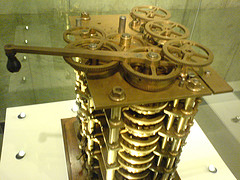
Babbage’s Difference Engine, in action

differenceA nice and accurate replica of Charles Babbage’s Difference Engine was built in California last year and is now on display at the Computer History Museum in Mountain View, CA.

Not newsworthy, but if you’ve never seen this machine in action, the short video is well worth a look. It’s fun to listen to it clatter, and to watch the helical patterns it makes.

National Public Radio did a story this morning:

The Difference Engine fills half a gallery and stands taller than most men. It’s 5 tons of cast iron, steel and bronze woven together from 8,000 distinct parts. Though it looks like it could be a sculpture, the machine is essentially a giant calculator. Tim Robinson, a docent at the museum, says it’s “the first automatic calculating machine.”

This engine — made from 162-year-old designs — doesn’t have a power pack; it has a hand crank. Robinson works up a sweat as he turns it. “As long as you keep turning that crank, it will produce entirely new results,” he says.

Most importantly, the machine produces accurate results. In Babbage’s time, England reigned over a vast global empire. To navigate the seas, captains used books filled with calculations — but these equations were all done by fallible human minds.

What if, indeed.

[Image: kalleboo]