Tag Archives: computer

The Hail Mary Cloud: slow but steady brute-force password-guessing botnet

Hail MaryDid you hear about the recent exploit of jailbroken jesusPhones? Yeah, the Rick-rolling one (though that wasn’t strictly the original exploit, rather some Australian script-kiddie’s repurposing of a Dutch exploit from earlier in the month); to sum it all up in a sentence, bad things can happen to your hardware if you install software without changing the default password. As a sensible and experienced web denizen, you knew that already, of course.

But when you set or change a password, you’d better make the effort to think up a good one. Countless studies have shown how easy it is for black-hat types to guess the most common passwords (or alternatively social-engineer them out of you), but the ease of guessing is going to increase rapidly very soon, thanks to something one free software geek from Norway is calling the Hail Mary Cloud. [image by Anna Gay]

Yeah, I know, the pop-culture reference is a bit obscure, so I’ll sum it up for you: the Hail Mary Cloud is essentially a brute-force password-guessing botnet that has been scraping away at SSH daemons in recent months. A Mechanical Turk method of botnet expansion, in other words; why wait for someone to click on a spam email link when you can prise open a back-door on a webserver somewhere? [via SlashDot]

Each attempt in theory has monumental odds against succeeding, but occasionally the guess will be right and they have scored a login. As far as we know, this is at least the third round of password guessing from the Hail Mary Cloud, but there could have been earlier rounds that escaped our attention.

The fact that we see the Hail Mary Cloud keeping up the guessing is a strong indicator that there are a lot of guessable passwords and possibly badly maintained systems out there, and that even against the very long odds they are succeeding often enough in their attempts to gain a foothold somewhere that it is worth keeping up the efforts. For one thing, the cost of using other people’s equipment is likely to be quite low.

There are a lot of things about the Hail Mary Cloud and its overseers that we do not know. People who responded to the earlier articles with reports of similar activity also reported pretty consistently something like a sixty to seventy percent match in hosts making the attempts.

With 1767 hosts in the current sample it is likely that we have a cloud of at least several thousand, and most likely no single guessing host in the cloud ever gets around to contacting every host in the target list. The busier your SSH deamon is with normal traffic, the harder it will be to detect the footprint of Hail Mary activity, and likely a lot of this goes undetected.

If you’re worried, you’re thinking right – even the most complex of passwords can be guessed if you’ve got enough processor cycles (and available attempts) to spare. If the Hail Mary Cloud grows big enough, the era of the password as an even partially effective security method may be over… so start genning up on public key encryption now and avoid the rush.

The Mechanics of Morality: Why Moral Choices in Video Games Are No Longer Fun

Moral ambiguity is an increasingly ubiquitous part of modern computer game character mechanics – so why are the moral elements to gameplay increasingly less enjoyable?

Blasphemous Geometries by Jonathan McCalmont

###

I remember when having a game take into account the morality of your character was something of an innovation. I remember banging my head against the Eye of the Beholder Dungeons and Dragons games appalled at the fact that something as complex as tabletop role-playing had been reduced to throwing knives at spiders in someone’s basement. The Baldur’s Gate games changed this. Suddenly, if you played an evil character good characters refused to join up with you and if you played a good character then certain solutions to problems were denied you. It was a revelation. Now it all tastes like ashes. Continue reading The Mechanics of Morality: Why Moral Choices in Video Games Are No Longer Fun

Biomimicry in computer security: ants vs. worms

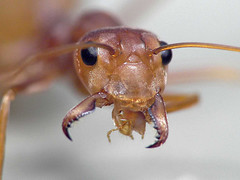
ant headWe have a tendency to name software entities after biological creatures whose behaviours they remind us of – think of viruses in general, or worms. Now a bunch of computer security geeks are coming from the other direction, taking inspiration from nature’s creatures for the next weapon in the never-ending war against malware and viruses… few species are more effective at responding to intrusions into their system than the ant, after all. [via SlashDot; image by CharlesLam]

Unlike traditional security devices, which are static, these “digital ants” wander through computer networks looking for threats, such as “computer worms” – self-replicating programs designed to steal information or facilitate unauthorized use of machines. When a digital ant detects a threat, it doesn’t take long for an army of ants to converge at that location, drawing the attention of human operators who step in to investigate.

The concept, called “swarm intelligence,” promises to transform cyber security because it adapts readily to changing threats.

“In nature, we know that ants defend against threats very successfully,” explains Wake Forest Professor of Computer Science Errin Fulp, an expert in security and computer networks. “They can ramp up their defense rapidly, and then resume routine behavior quickly after an intruder has been stopped. We were trying to achieve that same framework in a computer system.”

[…]

“Our idea is to deploy 3,000 different types of digital ants, each looking for evidence of a threat,” Fulp says. “As they move about the network, they leave digital trails modeled after the scent trails ants in nature use to guide other ants. Each time a digital ant identifies some evidence, it is programmed to leave behind a stronger scent. Stronger scent trails attract more ants, producing the swarm that marks a potential computer infection.”

Let’s just hope it takes the black-hat kids a long time to code up a software aardvark, eh?

Computers can now lip-read…

Ronald Reagan. Read his lips.… so watch what you say when the webcam’s plugged in, eh?

A research team from the School of Computing Sciences at UEA compared the performance of a machine-based lip-reading system with that of 19 human lip-readers. They found that the automated system significantly outperformed the human lip-readers – scoring a recognition rate of 80 per cent, compared with only 32 per cent for human viewers on the same task.

Furthermore, they found that machines are able to exploit very simplistic features that represent only the shape of the face, whereas human lip-readers require full video of people speaking.

The study also showed that rather than the traditional approach to lip-reading training, in which viewers are taught to spot key lip-shapes from static (often drawn) images, the dynamics and the full appearance of speech gestures are very important.

Using a new video-based training system, viewers with very limited training significantly improved their ability to lip-read monosyllabic words, which in itself is a very difficult task. It is hoped this research might lead to novel methods of lip-reading training for the deaf and hard of hearing.

Might this be a short-cut around the persistent problem of poor voice-recognition software? Why analyse the sound is you can do a better job by watching the face producing it? [via Technovelgy; image by i_forbes, chosen for an old yet oddly topical cultural reference that I suspect no one under 25 is likely to get]

Singularity lacking in motivation

motivationMIT neuroengineer Edward Boyden has been speculating as to whether the singularity requires the machine-equivalent of what humans call “motivation”:

I think that focusing solely on intelligence augmentation as the driver of the future is leaving out a critical part of the analysis–namely, the changes in motivation that might arise as intelligence amplifies. Call it the need for “machine leadership skills” or “machine philosophy”–without it, such a feedback loop might quickly sputter out.

We all know that intelligence, as commonly defined, isn’t enough to impact the world all by itself. The ability to pursue a goal doggedly against obstacles, ignoring the grimness of reality (sometimes even to the point of delusion–i.e., against intelligence), is also important.

This brings us back to another Larry Niven trope. In the Known Space series the Pak Protector species (sans spoilers) is superintelligent, but utterly dedicated to the goal of protecting their young. As such Protectors are incapable of long-term co-operation because individual protectors will always seek advantage only for their own gene-line. As such the Pak homeworld is in a state of permanent warfare.

This ties in with artificial intelligence: what good is being superintelligent if you aren’t motivated to do anything, or if you are motivated solely to one, specific task? This highlights one of the basic problems with rationality itself: Humean intrumental rationality implies that our intellect is always the slave of the passions, meaning that we use our intelligence to achieve our desires, which are predetermined and beyond our control.

But as economist Chris Dillow points out in this review of the book Animal Spirits, irrational behaviour can be valuable. Artists, inventors, entrepreneurs, and writers may create things with little rational hope of reward but – thankfully for the rest of society – they do it anyway.

And what if it turns out that any prospective superintelligent AIs wake up and work out that it isn’t worth ever trying to do anything, ever?

[via Slashdot, from Technology Review][image from spaceshipbeebe on flickr]