Tag Archives: computer

Swine flu compared to computer viruses

influenza virusHere’s an interesting link, coming to us via the one and only Bruce Schneier. Haker/maker type person Bunnie draws a fascinating analogy between influenza viruses (like our topical and quite possibly overhyped amigo, swine flu) and the computer viruses with which he is more familiar. The result? A computer geek’s guide to molecular biology…

For those not familiar with molecular biology, DNA is information-equivalent to RNA on a 1 to 1 mapping; DNA is like a program stored on disk, and RNA is like a program loaded into RAM. Upon loading DNA, a transcription occurs where “T” bases are replaced with “U” bases. Remember, each base pair specifies one of four possible symbols (A [T/U] G C), so a single base pair corresponds to 2 bits of information.

[…]

If you thought of organisms as computers with IP addresses, each functional group of cells in the organism would be listening to the environment through its own active port. So, as port 25 maps specifically to SMTP services on a computer, port H1 maps specifically to the windpipe region on a human. Interestingly, the same port H1 maps to the intestinal tract on a bird. Thus, the same H1N1 virus will attack the respiratory system of a human, and the gut of a bird. In contrast, H5 — the variety found in H5N1, or the deadly “avian flu” — specifies the port for your inner lungs. As a result, H5N1 is much more deadly because it attacks your inner lung tissue, causing severe pneumonia. H1N1 is not as deadly because it is attacking a much more benign port that just causes you to blow your nose a lot and cough up loogies, instead of ceasing to breathe.

Researchers are still discovering more about the H5 port; the Nature article indicates that perhaps certain human mutants have lungs that do not listen on the H5 port. So, those of us with the mutation that causes lungs to ignore the H5 port would have a better chance of surviving an Avian flu infection, whereas as those of us that open port H5 on the lungs have no chance to survive make your time / all your base pairs are belong to H5N1.

So how many bits are in this instance of H1N1? The raw number of bits, by my count, is 26,022; the actual number of coding bits approximately 25,054 — I say approximately because the virus does the equivalent of self-modifying code to create two proteins out of a single gene in some places (pretty interesting stuff actually), so it’s hard to say what counts as code and what counts as incidental non-executing NOP sleds that are required for self-modifying code.

So it takes about 25 kilobits — 3.2 kbytes — of data to code for a virus that has a non-trivial chance of killing a human. This is more efficient than a computer virus, such as MyDoom, which rings in at around 22 kbytes.

It’s humbling that I could be killed by 3.2kbytes of genetic data. Then again, with 850 Mbytes of data in my genome, there’s bound to be an exploit or two.

[image by kat m research]

The ethics of autonomous devices

heart_surgeonThe Royal Academy of Engineering in the UK says that the imminent rise of autonomous and semi-autonomous cars, robotic surgeons, planes, war machines, software agents, and public transport systems raises important ethical and legal questions:

Professor Stewart and report co-author Chris Elliott remain convinced that autonomous systems will prove, on average, to be better surgeons and better lorry drivers than humans are.

But when they are not, it could lead to a legal morass, they said.

“If a robot surgeon is actually better than a human one, most times you’re going to be better off with a robot surgeon,” Dr Elliott said. “But occasionally it might do something that a human being would never be so stupid as to do.”

Professor Stewart concluded: “It is fundamentally a big issue that we think the public ought to think through before we start trying to imprison a truck.”

And when and if true AI or artificial general human-level intelligences show up, will they commit crimes, and if so, who will be responsible?

[from the BBC][image from Wonderlane on flickr]

Biological cells as cloud computing networks

webIn an interesting confluence of ideas, and of the unintentional biomimicry at work in cloud computing, researchers identify parallels between biological cells and computer networks:
Gene regulatory networks in cell nuclei are similar to cloud computing networks, such as Google or Yahoo!, researchers report today in the online journal Molecular Systems Biology. The similarity is that each system keeps working despite the failure of individual components, whether they are master genes or computer processors, which paves a way to the next gen secure web gateway

“It’s extremely rare in nature that a cell would lose both a master gene and its backup, so for the most part cells are very robust machines,” said Anthony Gitter, a graduate student in Carnegie Mellon’s Computer Science Department and lead author of the Nature MSB article. “We now have reason to think of cells as robust computational devices, employing redundancy in the same way that enables large computing systems, such as Amazon, to keep operating despite the fact that servers routinely fail.”

It is fascinating how natural selection has already discovered many of the same processes used by human engineers.

[via Technut News, from ScienceDaily][image from Jus’ fi on flickr]

Who owns your electronics?

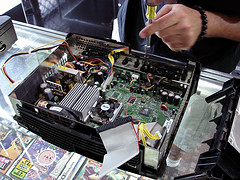
Xbox undergoing a (probably illegal) modification procedureGiven the ubiquity of the story at the moment, you may well have already heard about the Los Angeles man facing a potential ten year jail term for the heinous crime of modifying games consoles. If so, you may be wondering exactly how that law operates – after all, if you own something, shouldn’t it be your right to do what you wish with it? TechDirt highlights the disconnect:

It’s interesting to see the use of the word “jailbreaking” here, as that’s more commonly been applied to iPhones — where it’s common. Usually, this action has been referred to as “modding” or “modchipping” when it came to consoles. But the basic fact is that the actions are effectively the same — and both should be perfectly legal. Modifying legally purchased hardware should never be against the law. It’s possible that you could then use that modified hardware to break the law — and no one’s saying that’s okay. But the act itself of modifying the devices should never be against the law — especially where it could lead to a ten-year prison sentence, as in this case.

Ars Technica consulted a legal expert to get the real skinny on the situation:

The news was bad. “With hardware, you can do pretty much anything you want with it. There are very few rules that apply. You buy it, you own, you can take it apart, and that’s perfectly fine,” she explained. The problem is that no one simply modifies the hardware. “It becomes complicated with modern hardware because it’s combined with firmware, the embedded software.”

The infamous DMCA states that you can’t circumvent any software protection to get at the copyrighted work it protects. If you’re using a software exploit or installing a mod chip, you’re disabling that protection to allow yourself to run homebrew code, and you’re running afoul of the DMCA. “Thou shall not circumvent,” Granick told Ars, counting the two ways to break the law. “And thou shall not provide tools to others.

The intent is meaningless. Even if you simply want to modify an Xbox to use as a media center, you’re breaking the law, since you’ve given the system the ability to run unsigned code.

So, what’s clear is that Crippen’s arrest and charges are completely legal. What’s not so clear is whether or not they should be, and whether the potential penalty is even slightly proportional to the crime in question. Five years in the clink for modifying a single games console seems more than a little excessive, after all; here in the UK, the average house burglar doesn’t serve a stretch that long. [image by videocrab]

One suspects that, much as with the Thomas and Tenenbaum cases, the ESA is trying its best to make an example of Crippen, pour discourager les autres. How effective that could possibly be is anyone’s guess, but I wouldn’t want to bet on console modding disappearing any time too soon. Crippen himself makes the point pretty clear in the closing lines of Threat Level’s report:

Crippen appeared in Los Angeles federal court late Monday and was released on $5,000 bond.

He said it took about 10 minutes to jailbreak a console.

Where did he learn the skill?

Google, man.”

And there it is; I hope the ESA has a lot of nails, because the lid to Pandora’s Box isn’t going to close as easily as they’d like. The question is whether market forces will eventually turn people toward platforms with open source firmware, or ones which simply don’t come with any restrictions on what you can do with them – like the average desktop PC, for example.

The games console market grew strong in the days when most people couldn’t afford a powerful general purpose computer, but nowadays they’re cheap enough that people use them as little more than DVD players; what will it take for consumers to stop paying through the nose for the privilege of being locked into a piece of hardware where obsolescence and restricted use is an integral part of the package? The answer my gamer friends give me is that you just can’t get enough good games that run on PCs… which sounds to me like a market gap waiting to be exploited.

Will the next decade or so see an increase in locked hardware, or will openness become a strong selling point? Hell knows that when I can actually buy things like augmented reality spex, I’ll be buying the open-source ones that allow me to do whatever I want with them.

Games and economic misbehaviour

wolfram_fractalsGeorge Dyson has an excellent and compelling essay on game theory, economics, information theory, computer science, banking, finance, technology, and John von Neumann:

We are surrounded by codes (some Turing-universal) that make copies of themselves, and by physical machines that spawn virtual machines that in turn spawn demand for more physical machines. Some digital sequences code for spreadsheets, some code for music, some code for operating systems, some code for sprawling, metazoan search engines, some code for proteins, some code for the gears used in numerically-controlled gear-cutting machines, and, increasingly, some code for DNA belonging to individuals who serve as custodians and creators of more code. “It is easier to write a new code than to understand an old one,” von Neumann warned.

The monograph over on Edge discusses von Neumann’s intellectual antecendants and the development of game theory and statistical modelling. It also includes some interesting commentary on our recent economic difficulties. Definitely worth a read.

[image from kevindooley on flickr]