Tag Archives: environment

Europe: less people, mo’ problems?

Global population density mapLeading on neatly from Tom’s post about sustainable population growth is another New Scientist piece, which posits that Europe’s predicted decline in population will actually bring a whole raft of economic and infrastructural problems with it:

… look a little deeper, and the picture becomes more complicated. Decreasing population does not necessarily promise environmental benefits. The cost per head of population for infrastructure such as sewage systems or electricity supply increases when population numbers go down, making clean water and non-polluting energy even more expensive than they are today.

So can Europe overcome its demographic and ecological challenges at the same time? The solution might be found in a rarely discussed concept: demographic sustainability.

High population growth, such as that now taking place in many African countries, is not sustainable. But very low fertility rates are unsustainable too. It will be hard for countries with persistently low fertility to remain competitive, creative and wealthy enough to keep ahead of their country’s environmental challenges. What is needed is a middle ground.

A demographically sustainable Europe needs to have a stable or slowly shrinking population as the existing infrastructure operates most efficiently when the number of inhabitants remains fairly constant. What would it take to achieve this? At present, the average fertility rate in Europe is 1.5 children per woman, and in countries below this line there is an urgent need for family policies to encourage women to have more children. Countries with fertility rates above 1.8, including France, the UK and Sweden, do not need further pro-birth policies as immigration will fill the demographic gap.

I’m not going to contest the maths, but I think pro-birth policies will probably be unnecessary. Climate change is going to produce a whole lot of environmental refugees in the next few decades, and those countries with a declining birth rate could open their borders to them – two birds with one stone, if you will.

However, if those countries also happen to be the ones most paranoid about being “overrun” by immigrants, I guess it’s back to the government-sponsored Have More Kids campaigns… [awesome CGI population density map image by Arenamontanus]

[ For the record, I think that it behoves us as a sentient species to limit our population so as to best protect and sustain the environment that keeps us alive (and hence protect and sustain ourselves). However, sentience and sense have never directly proportional, and show little sign of becoming so any time soon… so I guess mitigating the fallout is the best plan in the meantime. ]

India to export thorium nuclear reactors

wheels_and_cablesCharles Stross highlights the news that the Indian government is preparing to manufacture and export nuclear reactors that use the thorium fuel cycle:

The original design is fuelled by a mix of uranium-233 and plutonium bred from thorium using fast neutron power reactors earlier in a thorium fuel cycle. The LEU variant is suitable for export because it does away with the plutonium, replacing it with uranium enriched to 19.75% uranium-235.

As countries like India and China continue to industrialise we will see more and more technological innovation from these developing countries. Both India and China are hungry for cheap energy to raise the standard of living for their people. This thorium reactor design is important because it can be used by developing countries with minimal industrial infrastructure:

The design is intended for overseas sales, and the AEC [India’s Atomic Energy Commission] says that “the reactor is manageable with modest industrial infrastructure within the reach of developing countries.”

The reactor design is intended minimise the threat of nuclear proliferation, as it does not produce the right amount of bomb-worthy plutonium-239, and the long-term high-level waste is also minimised. All in all, it looks like a really excellent piece of hardware, and a thoroughly Good Thing.

Thorium is more plentiful than uranium and offers the opportunity of a long-term low-CO2 energy base. I strongly suspect that when the brown-outs start there will be huge public demand for a solution, as it will be difficult for the UK to generate all its energy needs using renewables, and it could well be that the UK ends up buying thorium reactors from India or pebble-bed reactors from China to secure our energy future.

[via Charles Stross, from World Nuclear News][image from Shahram Sharif on flickr]

Tobias Buckell on marine conservation and his next novel

I like to keep an eye on what former members of the Futurismic family are getting up to. Back when I joined the crew, one of my fellow bloggers was Tobias Buckell; nowadays he’s too busy with writing novels to contribute here, and bravo to him for that – it’s always nice to see good people getting along in the world.

Toby has just been interviewed by marine conservation site The Reef Tank, and in amongst talking about his connection to the oceans – he grew up aboard a boat in the Caribbean – he drops some hints about his next novel project:

My next novel is called Arctic Rising. For a while now in short fiction I’ve written a few stories that play around with the consequences of failed cities, ecological disaster, global warming, and so on. I’ve never thought of myself as well informed enough to write about these topics, but looking around I see very little fiction engaging these concepts. It comes back to that background awareness I have, I’ve never thought I knew as much as I actually do. Before the hurricane season of 1995, when we lost our boat, divers were talking in the boating community about how much warmer the water was deep below the surface than normal. We figured that might mean a rough storm season, and we were right. One near hurricane and two hurricanes all in a near row.

So I’ve started writing some stories about what happens when the polar ice cap opens up to become a regular ocean as it melts, with shipping traffic and nations jockeying for resources up there. And all that thinking about that with my fellow writers Paolo Bacigalupi and Karl Schroeder convinced me my next book should be about this sort of stuff that’s thirty or so years down the road.

That’s one to watch out for – I’ll be interested to see how Toby’s novel-length work comes out with a near-future setting instead of space-opera scope. If you ever want to run any exclusive excerpts, Toby, you know who to email, right? 😉

Boat-cleaning robots for a greener ocean?

autonomousunBarnacles, oysters, algae, and other sea-life can slow a ship by 10% and increase fuel consumption by as much as 40%. The U.S. Office of Naval Research is testing a Roomba-like autonomous hull-cleaning robot to cut the drag.
The robot incorporates the use of a detector that utilizes modified fluorometer technology to enable the robot to detect the difference between the clean and unclean surfaces on the hull of a ship. Used to groom ships in port, the Hull BUG [Bio-inspired Underwater Grooming tool] removes the marine biofilm and other marine organisms before they get solidly attached. This is especially important because Navy ships spend more than 50 percent of their service life in port, giving barnacles and marine life ample time to become settled and, if allowed, to further colonize and grow on the ship’s hull.

Underscoring the benefits of combining the Hull BUG with newly developed environmentally benign antifouling hull coatings, [ONR Program Officer Steve] McElvany estimates that “the Navy will save millions of dollars per year in fuel. Using less fuel also means less carbon dioxide in the atmosphere.”

[Photo: U.S. Navy]

Joe Robot vs. the Volcano: the spiderbots of Mount St Helens

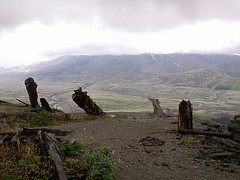
Mount St Helens shrouded in cloudIn order to keep a close eye on Mount St. Helens, the NASA JPL people have built and deployed a bunch of networked “spiderbots” which negotiate a peer-to-peer network between each other in order to pass data back to base.

Fifteen spiderbots, so-named because of the three spindly arms protruding from their suitcase-sized steel bodies, were lowered from a helicopter to spots inside the crater and around the rim of Mount St Helens, an active volcano in the US state of Washington, in July.

Each has a seismometer for detecting earthquakes, an infrared sensor to detect heat from volcanic explosions, a sensor to detect ash clouds, and a global positioning system to sense the ground bulging and pinpoint the exact location of seismic activity.

Once in place, the bots reached out to each other to form what is known as a mesh network. “It’s similar to the internet,” says Steve Chien, the principal scientist for autonomous systems at JPL. “You just lay them out, and they figure out the best way to route the data.”

Smart idea: install a remote monitoring system and instruct it to drop you a line with any problems… up to and including any problems with the system itself as well as the volcano, one assumes.

Obviously the expense means that this sort of system is currently only of use in high-risk and high-budget applications, but it’s no great mental stretch – given the rapid advances of networking technology – to imagine entire states or countries blanketed with similar monitoring frameworks.

Then make the data public, bolt on an API and distribute something like the SETI@home software, and everyone with some spare processor cycles can help keep an eye on geological instabilities. Similar systems (or perhaps even the same devices) could be used to provide communications infrastructure in the aftermath of a disaster, too. [image by christmaswithak]