
Tag Archives: robots

The ethics of autonomous devices

heart_surgeonThe Royal Academy of Engineering in the UK says that the imminent rise of autonomous and semi-autonomous cars, robotic surgeons, planes, war machines, software agents, and public transport systems raises important ethical and legal questions:

Professor Stewart and report co-author Chris Elliott remain convinced that autonomous systems will prove, on average, to be better surgeons and better lorry drivers than humans are.

But when they are not, it could lead to a legal morass, they said.

“If a robot surgeon is actually better than a human one, most times you’re going to be better off with a robot surgeon,” Dr Elliott said. “But occasionally it might do something that a human being would never be so stupid as to do.”

Professor Stewart concluded: “It is fundamentally a big issue that we think the public ought to think through before we start trying to imprison a truck.”

And when and if true AI or artificial general human-level intelligences show up, will they commit crimes, and if so, who will be responsible?
[from the BBC][image from Wonderlane on flickr]

Re-engineering biology

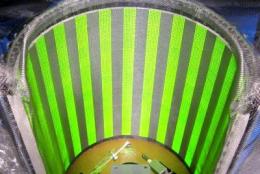
roboticsinsiAs I’ve mentioned before, we’re entering a new phase of technological progress: engineers and technologists are not just seeking inspiration in the mechanisms of the natural world, but are actually reverse- and re-engineering biology to improve synthetic technology. In this case researchers in Germany are studying how bow flies perform their incredible feats of aerial acrobatics by creating a wind tunnel for blow flies (pictured):

A fly’s brain enables the unbelievable – the animal’s easy negotiation of obstacles in rapid flight, split-second reaction to the hand that would catch it, and unerring navigation to the smelly delicacies it lives on.

Yet the fly’s brain is hardly bigger than a pinhead, too small by far to enable the fly’s feats if it functioned exactly the way the human brain does. It must have a simpler and more efficient way of processing images from the eyes into visual perception, and that is a subject of intense interest for robot builders.

While researchers use biomimetic inspiration for the development of flying robots other scientists are working to reprogram existing biological technology, in this case altering bone marrow stem cells so that they function as retinal cells:

University of Florida researchers were able to program bone marrow stem cells to repair damaged retinas in mice, suggesting a potential treatment for one of the most common causes of vision loss in older people.

The success in repairing a damaged layer of retinal cells in mice implies that blood stem cells taken from bone marrow can be programmed to restore a variety of cells and tissues, including ones involved in cardiovascular disorders such as atherosclerosis and coronary artery disease.

For all the pessimism about the future of human civilisation, it is exhilerating to live in an era with so many opportunities and challenges.

[both from Physorg][image from Physorg]

Do android sheep dream of electric grass?

sheepThe current obsession for the military robotics crowd appears to be solving the long-term fuelling issue – after all, your ‘bot isn’t much use if it has to return to base every six hours for a fresh battery (possibly leading the enemy to your emplacement in the process).

So, an autonomous robot needs to be able to forage for fuel; while the art world has gone so far as to produce robots that eat insects and animals, the military contractors are keeping things strictly vegetarian, designing the cutely-monikered EATR to graze like a sheep on biomass.

Robotic Technology of Potomac, Md., and Cyclone Power Technologies of Pompano Beach, Fla., have completed an initial stage in a collaboration that could lead to the world’s first grazing robot. The system would obtain energy by “engaging in biologically-inspired, organism-like, energy-harvesting behavior”–in other words, foraging and eating to keep itself going.

It’s a tall order. The robot will need to first identify a suitable biomass (wood, grass, paper, etc.) and avoid the indigestible (rocks, metal, or glass). It must spatially locate and manipulate the source; cut or shred to size, then use its robotic arm and “end effectors” to grab, lift and dump it into the furnace, where it will be ingested and converted to enough electrical energy to power the robots systems. This stage is taken care of by the Cyclone engine, a modern-day external combustion, steam engine that can run on virtually any fuel.

I wonder if there’ll be a desert variant designed to survive for long periods without any biomass – an electric camel, perhaps? Mash up the fuelling tech with that scary yet awesome Big Dog pack-animal bot and you’ve got a new ship of the desert that (hopefully) won’t spit at you when it’s in a bad mood… [via Technovelgy; image by David Masters]

Our new cyborg insect overlords

livesilkmothContinuing the robotic insect theme: researchers in Japan are developing the means to recreate the brains of insects in electronic circuits and thus modify existing insect brains to perform useful tasks, like finding narcotics, and earthquake victims:

In an example of ‘rewriting’ insect brain circuits, Kanzaki’s team has succeeded in genetically modifying a male silkmoth so that it reacts to light instead of odour, or to the odour of a different kind of moth.

Such modifications could pave the way to creating a robo-bug which could in future sense illegal drugs several kilometres away, as well as landmines, people buried under rubble, or toxic gas, the professor said.

Kanzaki also observes how remarkably adaptable biological organisms are:

“Humans walk only at some five kilometres per hour but can drive a car that travels at 100 kilometres per hour. It’s amazing that we can accelerate, brake and avoid obstacles in what originally seem like impossible conditions,” he said.

Our brain turns the car into an extension of our body,” he said, adding that “an insect brain may be able to drive a car like we can. I think they have the potential.

It certainly raises interesting questions about how to achieve intelligent machinery: why reinvent the wheel creating strong AI? We can reverse engineer animals that fly or hunt then adapt them to our purposes.

[from Physorg][image from Physorg]