Tag Archives: robots

The robots are hungry (and horny)

Everybody loves robots, but how will you keep your domestic systems running when energy supply is expensive or sporadic? Jimmy Loizeau and James Auger have an answer straight out of classic science fiction dime novel territory – you design them to consume organic matter. Organic matter from the corpses of household vermin.

The pests are lured in and digested by an internal microbial fuel cell. This exploits the way microbes generate free electrons and hydrogen ions when oxidising chemicals for energy. Electronics can be powered by directing the electrons around an external circuit before reuniting them with the ions.

“As soon as there is a predatory robot in the room the scene becomes loaded with potential,” Auger told New Scientist. “A fly buzzing around the window suddenly becomes an actor in a live game of life, as the viewer half wills it towards the robot and half hopes for it to escape.”

Although, for now, the robots rely on mains power, Auger believes they could become truly self-sufficient. “If the system fails, the grid goes down and all humans die, these robots could go on living so long as the flies don’t go with us.”

Machines with a taste for flesh – what could possibly go wrong? [via MetaFilter]

In other robot news, Sega have bought and rebadged WowWee’s unsuccessful FemiSapien robot, which now goes under the name EMA (Eternal Maiden Actualization – sounds like a transhuman manga title, AMIRITE?) as a potential mechanical girlfriend.

The robot […] is designed to pucker up for nearby human heads, entering “love mode” using a series of infrared sensors powered by battery.

“Strong, tough and battle-ready are some of the words often associated with robots, but we wanted to break that stereotype and provide a robot that’s sweet and interactive,” said Minako Sakanoue, a spokeswoman for the maker, Sega Toys to Reuters news agency.

“She’s very lovable and though she’s not a human, she can act like a real girlfriend.”

EMA can also hand out business cards, sing and dance.

Originally designed for the teen girl market, for some inexplicable reason the FemiSapien just didn’t click with her target demographic; whether the male otaku lobby will take to her inherently platonic charms remains to be seen. Personally, I’d hold out for an augmented reality idoru; if nothing else, she’d take up less space on my desk. [also via MetaFilter]
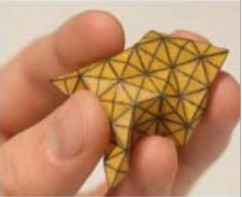
Cube a breakthrough in smart matter

darpa_origami2DARPA are still at it busily inventing the all the science-fictional goodness we expect and deserve. Now they’re going in for programmable matter, of a similar flavour to that found in Fire upon the Deep by Vernor Vinge, Accelerando by Charles Stross, and Dune: The Butlerian Jihad by Brian Herbert and Kevin J. Anderson. The goal of the project is to create matter that can “self-assemble or alter their shape, perform a function and then disassemble themselves.”:

One day, that could lead to “morphing aircraft and ground vehicles, uniforms that can alter themselves to be comfortable in any climate, and ’soft’ robots that flow like mercury through small openings to enter caves and bunker complexes.” A soldier could even reach into a can of unformed goop, and order up a custom-made tool or a “universal spare part.”

One team from Harvard is working on a kind of “generalized Rubik’s Cube” that can fold into all kinds of shapes. Another is trying to order large strands of synthetic DNA to bind together in a “molecular Velcro.” An MIT group is building “’self-folding origami’ machines that use specialized sheets of material with built-in actuators and data. These machines use cutting-edge mathematical theorems to fold themselves into virtually any three-dimensional object.

Very powerful and potentially gamechanging. Presumably if and when these become available to the general public they will have various restrictions built into them that will promptly be overcome and hacked origami-tools will become the ultimate criminal penknife.

On a more cheerful not this have wonderful applications in art and performance.

[from Danger Room]

Is a Terminator scenario possible?

metropolis h+ Magazine conducted a poll of “roboticists, AI workers, SF writers, and other techie types” (the SF writers were David Brin and Vernor Vinge) to see if they thought a “Terminator-like scenario” was possible, and if so, how likely it was. (Via KurzweilAI.net.)

Boiling it down (read the whole thing here), the consensus seems to be 1) forget about the time travel; 2) don’t expect a super-intelligent Skynet to spontaneously awaken and start wiping us out (though rather alarmingly, it was generally thought that was just “highly unlikely,” not flat-out impossible); but 3) do expect a future full of robots, both beneficial and warlike–though in the latter case, the intelligence directing them is likely to be humans of a destructive bent, rather than an AI with its own designs on the planet.

Knowing what humans are capable of, this is not much comfort.

Even though I am by nature optimistic.

(Image: 1935 tobacco card of Fritz Lang’s movie Metropolis, from Film Virtual History.)

[tags]robots, Terminator, artificial intelligence, science fiction, robotics, predictions[/tags]

Little lost robot

Robots have been mobile for decades, but they’ve only ever been able to go places for which they had a map or set of directions stored. That’s all changed thanks to a team of roboticists from Munich, who’ve built the first robot that can be unleashed into unfamiliar territory without a map. How does it complete its journey? It asks for directions, of course:

ACE uses cameras and software to detect humans nearby, based on their motion and upright posture. As it closes in on a likely helper, ACE’s “head” – bearing a touchscreen and a second screen displaying an animated mouth – turns to face the chosen person.

A speaker working in sync with the animated mouth is used to get the person’s attention and to ask them to touch the screen if they want to help. Willing guides are then asked to point the robot in the correct direction, with the response being analysed by posture recognition software. Direction set, ACE says “thank you” before trundling off.

Pointing, rather than telling the robot where to go, avoids confusion caused by the fact that the robot and the facing pedestrian each have a different sense of left and right.

Although it interacted with 38 people over a period of nearly five hours – ACE did eventually reach its destination. In fact, the team report that the robot was making very good progress until it reached a busy pedestrian area where its own popularity became a problem.

The current rarity of mobile robots in public spaces is obviously a big factor here; in a few more decades, we may barge past lost robots on the pavement as quickly and guiltily as we do homeless people or street-drunks.

The principle on display here is that of robot-human interaction in order to gather environmental data to complete a task or journey, which is all well and good, but it’s a proof-of-concept more than anything else. If all you needed was a robot that could navigate an unfamiliar cityscape, it’d be far easier to kit it out with good visual sensors and a GPS unit.

Hell knows this would be useless for military applications; if your super-killbot had to stop at every enemy checkpoint to ask the way to headquarters, I dare say the best place it would end up would be a long long way from anything at all… [story via regular commenter Evil Rocks; apologies to Paul McAuley for the headline]

And I, for one, welcome our new robot scientists

robot with laptopRobots are ideal for doing human tasks that are repetitive, like screwing lids on cosmetic bottles, welding car panels… and now making scientific discoveries. Columbia University’s “Adam” machine is “the first automated system to complete the cycle from hypothesis, to experiment, to reformulated hypothesis without human intervention”.

The demonstration of autonomous science breaks major ground. Researchers have been automating portions of the scientific process for decades, using robotic laboratory instruments to screen for drugs and sequence genomes, but humans are usually responsible for forming the hypotheses and designing the experiments themselves. After the experiments are complete, the humans must exert themselves again to draw conclusions.

[snip]

They armed Adam with a model of yeast metabolism and a database of genes and proteins involved in metabolism in other species. Then they set the mechanical beast loose, only intervening to remove waste or replace consumed solutions. […]

Adam sought out gaps in the metabolism model, specifically orphan enzymes, which scientists think exist, but which haven’t been linked to any parent genes. After selecting a desirable orphan, Adam scoured the database for similar enzymes in other organisms, along with the corresponding genes. Using this information, it hypothesized that similar genes in the yeast genome may code for the orphan enzyme.

The process might sound simple — and indeed, similar “scientific discovery” algorithms already exist — but Adam was only getting started. Still chugging along on its own, it designed experiments to test its hypotheses, and performed them using a fully automated array of centrifuges, incubators, pipettes, and growth analyzers.

After analyzing the data and running follow-up experiments — it can design and initiate over a thousand new experiments each day — Adam had uncovered three genes that together coded for an orphan enzyme. King’s group confirmed the novel findings by hand.

Score one for the Singularitarians – autonomous systems that can follow the scientific method without supervision would surely be a component of an emergent self-improving artificial intelligence, if I understand the theory correctly. [image by jurvetson]

And why not outsource our more tedious scientific tasks to robot underlings? After all, we’ve been fairly unhesitating in our rush to do the same with warfare… no matter how ethically blurred an idea that may be: