Tag Archives: science

Nanoscale etchings make liquid flow uphill

OK, I can’t resist it – here’s an OMGZ SCIENCE!!1 story that is too good to pass up: nanoscale laser etchings on metallic surfaces can produce weird effects in their interaction with liquids, including the ability to make them flow against gravity.

Chunlei Guo, associate professor of optics at the University of Rochester in New York State, says: “We’re able to change the surface structure of almost any piece of metal so that we can control how liquid responds to it. We can even control the direction in which the liquid flows, or whether liquid flows at all.

That’s pretty cool in and of itself, but here’s your real sensawunda kick:

Guo and his assistant, Anatoliy Vorobyev, alter the surface of the metal using an ultra-fast burst of light from a laser. Science Daily reports: “The laser, called a femtosecond laser, produces pulses lasting only a few quadrillionths of a second—a femtosecond is to a second what a second is to about 32 million years.” It adds that this one burst unleashes as much power as the whole of North America’s electric grid delivers, but “focused onto a spot the size of a needlepoint”.

Science FTW! It’s days like this I wish I’d actually finished my undergraduate courses…
Map of science

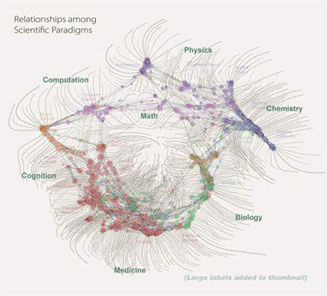
science_topic_mapSomething wonderful, not especially relevant to science fiction, but pretty and cool:

As to what the image depicts, it was constructed by sorting roughly 800,000 scientific papers into 776 different scientific paradigms (shown as red and blue circular nodes) based on how often the papers were cited together by authors of other papers.

Links (curved lines) were made between the paradigms that shared common members, then treated as rubber bands, holding similar paradigms closer to one another when a physical simulation forced them all apart: thus the layout derives directly from the data. Larger paradigms have more papers. Labels list common words unique to each paradigm.

It tickles my sensawunda node that we can now visualise our understanding of the physical universe in this way. Look at the map in close-up here.

You can see the great flowering coagulations of health, medicine, cell biology, and biochemistry. And brain research in the midst of a three-way tug-of-war between computer science, social science, and the study of the central nervous system (which is winning).

I wonder what this map will look like in a hundred years?

[image from Information Esthetics][via Eric Drexler]

Cosmic ray global warming debunked; deep ocean conveyors rethought

sun, clouds and seaOne of the more popular alternatives to anthropic global warming theories has been the cosmic ray hypothesis – the notion that changes in the sun’s output of cosmic rays are responsible for the planet’s recent changes in temperature. However, it’s always been short on evidence (much shorter than the theories it is intended to topple, funnily enough), and now new research has put another nail in its coffin lid:
In research published in Geophysical Research Letters, and highlighted in the May 1 edition of Science, Adams and Pierce report the first atmospheric simulations of changes in atmospheric ions and particle formation resulting from variations in the sun and cosmic rays. They find that changes in the concentration of particles that affect clouds are 100 times too small to affect the climate.

[…]

Despite remaining questions, Adams and Pierce feel confident that this hypothesis should be laid to rest. “No computer simulation of something as complex as the atmosphere will ever be perfect,” Adams said. “Proponents of the cosmic ray hypothesis will probably try to question these results, but the effect is so weak in our model that it is hard for us to see this basic result changing.”

As the researchers point out, these results are based on a computerised model of phenomena, and it could (and doubtless will) be asserted that it may not have any bearing on reality. In the absence of a model of similar complexity and expertise that supports the solar wind warming theory, however, I think I’m going to accept it as having been laid to rest. YMMV. [via DailyGalaxy]

While we’re talking about complex climate models, though, it looks like some rethinking will be required with respect to the ways in which deep-ocean circulation functions; experiments involving the dispersal of sensor-laden floats have revealed that a ‘conveyor belt’ of cold water flowing southward from the Labrador Sea doesn’t actually form a loop with the Gulf Stream as previously assumed.

I’d lying if I said I totally understood what this means (I’m not an oceanographer, nor do I play one on television), but what’s clear is that scientists aren’t just cherry-picking evidence that suits their models; they’re actively looking to improve the accuracy of their calculations all the time. Who’d have thought, eh? [via SlashDot; image by notsogoodphotography]

[Welcome back, JasperPants. ;)]

Garage ribofunk – the rise of homebrew genetic engineering

digital rendering of DNAHere’s another story that keeps bouncing back… and receiving progressively more paranoid coverage the closer it gets to mainstream news sources, too. That said, a certain amount of concern about biohacking or DIY genetic engineering is probably sensible – as much as most of the hobbyists brewing up weird bugs in their broom-closets are the sort of cheery can-do geeks who want to help, the ever-lowering barriers to entry of these technologies mean that it wouldn’t take much for someone with more nefarious purposes in mind to get themselves started:

… some researchers and law-enforcement officials have raised red flags. In a paper published in Nature Biotechnology in 2007, a group of scientists and FBI officials called for better oversight of so-called synthetic DNA, an ingredient widely used by professional biologists and hobbyists, saying it could theoretically lead to the creation of harmful viruses like Ebola or smallpox, since their genomes are available online. “Current government oversight of the DNA-synthesis industry falls short of addressing this unfortunate reality,” the paper said.

Ms. Aull, who lives with a cat and three roommates who are “a little bit weirded out” by her experiments, says the worries are overblown. DIY biologists are trying to “build a slingshot,” she says, “and there are people out there talking about, oh, no, what happens if they move on to nuclear weapons?”

Other biohackers argue that Mother Nature is more likely than any home hobbyist to create dangerous new pathogens. They cite the current A/H1N1 “swine flu” virus, which is a made-in-the-wild brew of human, bird and pig influenzas. Mackenzie Cowell, a founder of DIY Bio, says members aim to do good and are committed to working safely.

Frankly, I’m quite surprised that this movement hasn’t been stamped on more thoroughly and quickly; the post-9/11 world hasn’t exactly been kind to anything that can raise a pulse (and sell newspapers) simply by having the word ‘terrorism’ bolted on to it. Perhaps the DHS see themselves in a future alliance with the Shapers against those pesky Mechanist kids from cyberspace[via PosthumanBlues; image by ynse]

God of the gaps and the limits of science

thoughtAcademic Jon Taplin highlights this WSJ piece on quantum entanglement and the theories of French physicist Bernard d’Espagnat:

In March, the 87-year-old Frenchman won the prestigious $1.5 million Templeton Prize for years of work affirming “life’s spiritual dimension.”

Based on quantum behavior, Dr. d’Espagnat’s big idea is that science can only probe so far into what is real, and there’s a “veiled reality” that will always elude us.

Many scientists disagree. While Dr. d’Espagnat concedes that he can’t prove his theory, he argues that it’s about the notion of mystery. “The emotions you get from listening to Mozart,” he says, “are like the faint glimpses of ultimate reality we get” from quantum experiments. “I claim nothing more.”

I am not familiar with Prof. d’Espagnat’s work. Is he talking about the God of the gaps or the Popperian problem of induction?

[image from P/\UL on flickr]