Tag Archives: UK

Down the co-op: wind farms in the UK

Good news on the alternative energy front: researcher Baidya Roy has found solutions to some problems with wind energy. There’s also an article here on wind-farm co-operatives in the UK:

The cooperative, which began production in March, is the first wind farm to be wholly owned by individuals in Britain, which with gales sweeping in from the Atlantic has the best wind resources in Europe.

“We have produced energy every day since then,” Adam Twine, a farmer who started the project 15 years ago on his plot of land by installing five wind turbines 49 metres (160 feet) in height.

Overall, the project cost eight million pounds (8.9 million euros, 11.9 million dollars), nearly 60 percent of which came from individual shareholders, with the remainder being funded by a bank loan that is to be repaid over the next eight to 10 years.

CO2 emissions resulting from the production, installation and the lifetime of the turbine, which stretches 25 years, will be offset in just six months.

This is quite a heartening story: it combines the best elements of top-down (government subsidy) and bottom-up (locally-owned co-operative organisation) energy solutions.

[from Physorg][image from pierreyves0 on flickr]

George Monbiot unimpressed by climate report

Environmentalist and activist George Monbiot is unimpressed by the the British Committee on Climate Change’s latest report, entitled Building a Low Carbon Economy, claiming it doesn’t go far enough in what it demands:

[The] report, published yesterday, is long, detailed and impressive. It has the admirable objective of trying to cap global warming at two degrees or a little more. This, it says, means that greenhouse gas pollution in the UK should fall by 80% by 2050 and by 31% by 2020.

But there’s a problem. There is no longer any likely relationship between an 80% cut and two degrees of warming. This gets a little complicated, but please bear with me while I explain why [the report’s] proposal is about as likely to stop runaway climate change as the Maginot Line was to hold back the Luftwaffe.

The key findings and suggestions of the report are summarised here. Monbiot believes further action than is suggested in the report is necessary, including raising the top rate vehicle excise duty from £400 to £3000, and reducing the number of airline landing slots in the UK to 5% of current capacity.
[image from kevindooley on flickr]

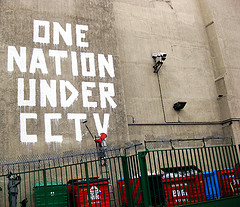
New UK smart CCTV cameras detect ‘precrimes’

"one nation under cctv" by BanksyLiving in a small city like mine, it’s not often one gets to feel that one is at the cutting edge of an emerging future society.

So how lucky for myself and the other residents of the over-stretched city of Portsmouth that we are the first town in the UK to be under the observation of Phildickian ‘smart’ CCTV cameras that are programmed to flag up an alert when they observe ‘suspicious behaviour’ that might indicate a crime is about to be committed.

You know, those sure-fire indicators of criminality… such as standing still for a while, or stopping to talk to someone. I would like to take this opportunity to praise the glorious leadership of Airstrip One for going to such efforts to ensure that any and all double-plus-ungood actions can be eradicated before they even have a chance to occur!

If anyone needs me, I’ll be typing a letter to the German Embassy requesting political asylum. [image by JapanBlack]

Win Wyndham’s five cozy catastrophes

The Midwich Cuckoos - John WyndhamGood news if you’re a fan of classic British sf novels – Penguin Books have just republished five of John Wyndham‘s “cozy catastrophe” books with fresh new artwork, and there’s a competition over at Forbidden Planet where you can get the chance to win them all by answering a ridiculously easy-to-Google question.

The only catch is that you have to sign up for a Forbidden Planet account (if you don’t already have one), but there’s worse outfits to get the occasional email from than a comics and genre fiction specialist, AMIRITE?

Pollen-coated bullets to identify shooters

45mm ammunitionResearchers over here in the UK are working on a way to make it easier to identify criminals using guns. Their solution? Using pollen and tiny granules of crystal, you attach a unique “nano-tag” to every cartridge – sort of like a bio-chemical barcode.

The nanotags are made from pollen, and a mix of grains of crystal oxides such as zirconia, silica and titanium oxide. Using varying combinations of crystal and pollen grains, it is possible to make large numbers of unique tags.

“We decided to work with pollens because they have a unique structure, resistant to temperature and easily recognisable,” said Paul Sermon from the University of Surrey, who has led the research. “It’s also easily dispersed and carried around in clothes, skin, etc.”

But what if the criminal in question has obtained the rounds by criminal means, leaving no record to tie them to the bullets?

In addition to the tags, the researchers are working on a way to have gun cartridges retain skin cells from anyone that handle them, for later DNA-based forensic analysis. Micro-scale grit can effectively trap cells and protect DNA from the heat of firing. Today, cartridges are smooth and rarely retain DNA or fingerprints.

Well, OK. It’s very near-future sf-nal, but there’s still one glaringly obvious major flaw with this idea – it only has a chance of catching people who buy (or steal) their cartridges from new and legitimate stock, and who leave the spent shells for the police to find.

If there’s already a black economy where guns can be converted, hacked and (in some cases) built from scratch, I can’t see them struggling to adapt to reloading old cartridges. My father used to do that with shotgun rounds back in the eighties, and it’s a simple enough procedure that even a kid in their teens could pick it up.

So all a wide implementation of this idea would actually achieve would be to drive ammunition manufacture underground, adding a new (and lucrative) industry to the black economy. Because, y’know, the black economy just isn’t busy and powerful enough already. The problem with technology: when you’ve got a hammer, everything looks like a nail. [image by mx5tx]