All posts by Tomas Martin

Writer and particle physics student from Bristol, England. My story 'A Shogun's Welcome' featured in Aberrant Dreams #7 and 'The Shogun and The Scientist' will be published in the anthology 'The Awakening' in January 2008. I review at SFCrowsnest and wrote the fictional blog miawithoutoil for the world without oil project.

Potentially life-supporting planet found

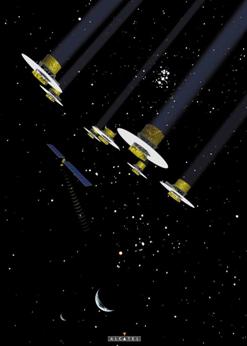
The four space-based 3 metre telescopes of DARWIN will work together to find other planetsAstronomers have discovered a planet in the 55 Cancri system that orbits constantly in what is know as the ‘habitable zone’ of the solar system. Although the planet is a gas giant some 45 times the size of Earth, there’s a good chance one of its moons might have liquid water and hence encourage the development of earth-like life. Planets are found by studying their transits across the light of a star. By studying the amount the star dims when the planet crosses, the size of the planet can be estimated. This is limited to larger planets currently but future missions like the Kepler and Darwin projects may be able to find rocky planets like our own.

The search for ‘exoplanets’ outside our solar system is hitting its stride and regularly more are found. Whilst the planets found to date are all ‘Jupiters’ like the gas giants further out in our home system, we know that Jupiter, Saturn, Neptune and Uranus all have large satellites. If any of these were in the habitable region where Earth is, the possibility of liquid water and hence bacterial life would be likely. If 55 Cancri did support life on one of its moons it would resemble the world of Coyote in Allen Steele’s excellent series.

[via the guardian, image of Darwin project via Astronomy Online]

Cirrus cloud disappearance may dampen global warming

Cirrus clouds high in the atmosphere lock heat into the EarthThe self-adjustment of the science consensus tends to make it reliable – credible research is promoted and those not backed out by evidence fall. So if the scientific consensus thinks global warming is a problem, I’m inclined to believe them. However, sometimes real science offers some positives, like today. Researchers at UAHuntsville’s Earth System Science Center found that the amount of heat-trapping Cirrus clouds in the atmosphere decreases rather than increases as global temperatures go up. High altitude clouds like Cirrus ones tend to trap heating escaping from the atmosphere, amplifying any existing warming (low altitude clouds tend to have the opposite effect by reflecting sunlight back into space).

It was expected that as temperatures rose, more evaporation would lead to more clouds. Studies of smaller warming and cooling cycles in the tropics showed that actually higher temperatures created less Cirrus clouds, encouraging a cooling period in reaction to the added heat. This negative feedback system is an exciting discovery and could cut the amount of temperature rises in global warming models by as much as 75%. It’s not a get out of jail card and it would still be prudent to work on a worst-case scenario basis but this kind of mechanism could give us the time needed to adapt to a lower carbon economy.

[via ScienceDaily, image by acewill]

Peak food is an inevitable consequence of peak oil

Vertical farming may save the cityCurrently for every 1 calorie of food, some 10 calories of energy are used to make it. As George Monbiot said in the Guardian last week, it is increasingly unclear where future supplies of water and phosphates will come from. After world war two the world population was around 3 Billion. Using newer techniques and fertilisers we have increased the amount of food an acre produces. The population has risen to match. Fertilisers are almost entirely all oil-based on large scale, however. With biofuels taking away land and oil prices rising as well as increased transportation costs, the current system of food from around the world is becoming a danger to supply. If the recent survey of 155 oil experts saying peak oil will come before 2010 turns out to be true, we will have to downscale very quickly indeed.

Two ways to combat this would also reverse many of the social changes of the last thirty or so years. Firstly, the reduction of food miles by producing stuff closer to home will bring down fuel needed to transport the food, often a massive contribution to the energy cost. The second involves fertilisers and other fuel-intensive techniques. As the amount of machinery and fertiliser brought into farms decreases due to prices, manual labour becomes increasingly important again. Eating less meat, particularly red meat, will reduce the amount of calories an acre of land can produce, as well as boosting our health. Large farms currently operating with few employees will need to split into smaller units and introduce nitrogen fixing vegetables between grain crops. On a social level this could increase the number of people making a small living for themselves off a plot of land, selling most of their produce locally. Using more varied crops, utilising the seasons and even vertical farming mean we could have good food even without shipping it in from abroad.

[photo by Chris Jacobs for The Vertical Farm Project]

Note: edited to attribute the photo to Chris Jacobs, who says: ‘For all of you out there…this illustration is NOT how a real vertical farm would be…it would be 100% hydroponic. This was just created to “show” growing food.’ – thanks for keeping us informed Chris!

80% of Mexican state underwater, oil production halts

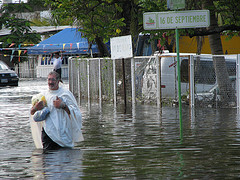
Mexico is struggling with all the water with further rain on the wayFollowing on from the recent fires across California, another catastrophe less widely reported is the flooding in Mexico. Tabasco is a southern state the size of Belgium and following storms and heavy rain, 80% of the land is underwater, with close to 100% of crops lost, around half of the two million population evacuated and production of crude in the oil-rich region at a standstill. The governor of the state has compared the situation for the 350,000 in the state capital Villahermosa to New Orleans post-Katrina and the rebuilding time is likely to be as long.

Like any natural disaster it would be hard to pinpoint this extreme weather directly on global warming but there has definitely been a large number of big-scale environmental catastrophes over the last few years. Whatever the cause, the damage to Mexico’s already-ailing oil industry will be a severe disruption and push us ever closer to the scary prospect of $100 barrels of oil.

[via Daily Kos, image by _…:::Celoide:::…_]

Joel Shepherd continues to hit paydirt with ‘Killswitch’

Joel Shepherd concludes his Cassandra Kresnov trilogy with a bang in KillswitchI’ve been reading the last in the trilogy of Cassandra Kresnov novels by Australian author Joel Shepherd and I’ve been very impressed. Following on from Crossover and Breakaway, Killswitch is set on the planet of Callay. In the peace after a war with the android-creating League, the more conservative Federation government has recently transferred its powers from Earth. The lead character is one of the androids, Cassandra Kresnov, a super-intelligent, super strong version of the more limited grunts used in the war. In the first book, Crossover she defects and moves to Callay, creating a huge political standoff between many different factions.

Shepherd writes a clever, multi-dimensional tale of artificial humans. It’s reminiscent of the great work done with the Cylon characters in the new Battlestar Galactica but impressively these books were first published in Australia before that TV series saw the light of day. The worldwide publication of the trilogy is richly deserved. As well as some gritty, dynamic action sequences and rich political worldbuilding, the characterization of Cassandra is spot-on. I’d recommend a lot of people pick up these books. You can read my review of Killswitch in this month’s SFCrowsnest.

[image of the books Pyr cover via SFCrowsnest]