All posts by Tom James

Hair you go: tracking by hair

hair_with_pensResearchers at the LGC Chemical Metrology Laboratory and the University of Oviedo in Spain have developed a technique to track a person’s movements between different countries using a sample of their hair:

The two most abundant sulphur isotopes in hair keratin are sulphur-32 (32S), which accounts for about 95 per cent, and sulfur-34 (34S), which makes up around 4 per cent. These proportions, however, vary according to people’s diets, and, unless they take their food with them, will therefore change when people travel.

Although this is described in terms of counter-terrorism, there is no reason why it couldn’t be used for anyone and everyone.

Police organizations, including the Metropolitan Police in London, have already shown interest in the technology.

So here is yet another way by which we can be tracked and our movements monitored.

[from Wired UK][image from Evil Erin on flickr]

Quantum superposition breakthrough

theory_actualA rich seam of technological and science-fictional ideas seem ready to be mined with the development of the first light trap that can simultaneously store different numbers of photons:

“These superposition states are a fundamental concept in quantum mechanics, but this is the first time they have been controllably created with light,” Cleland said. Martinis added, “This experiment can be thought of as a quantum digital-to-analog converter.” As digital-to-analog converters are key components in classical communication devices (for example, producing the sound waveforms in cell phones), this experiment might enable more advanced communication protocols for the transmission of quantum information.

The research is funded by IARPA. Intelligence services are understandably keen to learn more about the potential for quantum computers to break conventionally encrypted communications.

[image and story from Physorg]

Biotech to the stars

dendritesCentauri Dreams discusses a DNA-based self-replicating interstellar probe:

Think of a probe that gets around the payload mass problem by using molecular processes to create cameras and imaging systems not by mechanical nanotech but by inherently biological methods.

A Von Neumann self-replicating probe comes to mind, but we may not have to go to that level in our earliest iterations. The biggest challenge to our interstellar ambitions is propulsion, with the need to push a payload sufficient to conduct a science mission to speeds up to an appreciable percentage of lightspeed. The more we reduce payload size, the more feasible some missions become

This is similar to Robert L. Forward‘s starwisp concept (popularised by Charlie Stross in Accelerando).

I suspect that if and when we do get round to interstellar exploration it will involve sending small-mass packages that are capable of bootstrapping themselves to a broadcast/exploration mode using local materials on arrival in the target system.

It remains to be seen what kind of space-based molecular replicating systems become viable. Will we be able to create space-hardened bioware, or good ol’ fashioned machine phase fullerene nanotech?

[image from neurollero on flickr]

Loopy space elevator concept

rotatingspaceelevatorsIn the same general theme as Keith Loftstrom’s launch loop concept [via Speaktomanagers] we have the Rotating Space Elevator:

Golubović and Knudsen have introduced the Rotating Space Elevator (RSE), a rotating system of a floppy string that forms an ellipse-like shape. Unlike the traditional Linear Space Elevator (LSE) made of a single straight cable at rest, the RSE rotates in a quasi-periodic state.

“The idea came by itself,” Golubović told PhysOrg.com. “I was thinking how to make things move easily and quickly up the traditional Tsiolkovsky-type space elevators. In my kitchen, I was mixing coffee in my cup too vigorously and the centrifugal force on the rotating coffee won over gravity to make some of the coffee lift and splash out the cup. This was my ‘eureka’ that lead to adding a similar conceptual feature to the old space elevator idea…

[via Next Big Future][image from Physorg]

Map of science

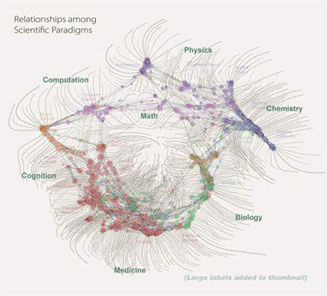
science_topic_mapSomething wonderful, not especially relevant to science fiction, but pretty and cool:

As to what the image depicts, it was constructed by sorting roughly 800,000 scientific papers into 776 different scientific paradigms (shown as red and blue circular nodes) based on how often the papers were cited together by authors of other papers.

Links (curved lines) were made between the paradigms that shared common members, then treated as rubber bands, holding similar paradigms closer to one another when a physical simulation forced them all apart: thus the layout derives directly from the data. Larger paradigms have more papers. Labels list common words unique to each paradigm.

It tickles my sensawunda node that we can now visualise our understanding of the physical universe in this way. Look at the map in close-up here.

You can see the great flowering coagulations of health, medicine, cell biology, and biochemistry. And brain research in the midst of a three-way tug-of-war between computer science, social science, and the study of the central nervous system (which is winning).

I wonder what this map will look like in a hundred years?

[image from Information Esthetics][via Eric Drexler]