The dystopians are out of step: humans are naturally optimistic

Democritus_by_Agostino_Carracci At least, that’s according to a new study from the University of Kansas and Gallup presented over the weekend at the annual convention of the Association for Psychological Science in San Francisco (via ScienceDaily):

Data from the Gallup World Poll drove the findings, with adults in more than 140 countries providing a representative sample of 95 percent of the world’s population. The sample included more than 150,000 adults.

Eighty-nine percent of individuals worldwide expect the next five years to be as good or better than their current life, and 95 percent of individuals expected their life in five years to be as good or better than their life was five years ago.

“These results provide compelling evidence that optimism is a universal phenomenon,” said Matthew Gallagher, a psychology doctoral candidate at the University of Kansas and lead researcher of the study.

At the country level, optimism is highest in Ireland, Brazil, Denmark, and New Zealand and lowest in Zimbabwe, Egypt, Haiti and Bulgaria. The United States ranks number 10 on the list of optimistic countries.

Demographic factors (age and household income) appear to have only modest effects on individual levels of optimism.

Now, has anyone actually conducted a scientific poll of science fiction writers to see how they stack up by comparison?

(Image: Democritus by Agostino Carracci, from Wikimedia Commons.)

[tags]public opinion, polling, optimism, dystopia, pessimism,psychology[/tags]
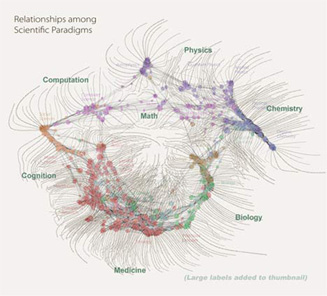
Map of science

science_topic_mapSomething wonderful, not especially relevant to science fiction, but pretty and cool:

As to what the image depicts, it was constructed by sorting roughly 800,000 scientific papers into 776 different scientific paradigms (shown as red and blue circular nodes) based on how often the papers were cited together by authors of other papers.

Links (curved lines) were made between the paradigms that shared common members, then treated as rubber bands, holding similar paradigms closer to one another when a physical simulation forced them all apart: thus the layout derives directly from the data. Larger paradigms have more papers. Labels list common words unique to each paradigm.

It tickles my sensawunda node that we can now visualise our understanding of the physical universe in this way. Look at the map in close-up here.

You can see the great flowering coagulations of health, medicine, cell biology, and biochemistry. And brain research in the midst of a three-way tug-of-war between computer science, social science, and the study of the central nervous system (which is winning).

I wonder what this map will look like in a hundred years?

[image from Information Esthetics][via Eric Drexler]

A life on the ocean wave: more seasteading concepts

Opinions differ as to whether seasteading is a plausible libertarian utopia or an unfeasible dream aimed at prising investment out of those whose desire to escape government control isn’t tempered by political realism, or something in between the two.

But one thing’s for sure – it’s an idea that catches people’s imaginations. National Geographic has images of the five winning entries of the Seasteading Institute’s design competition, and all of them have that science fictional *snap* – they look cool, futuristic and (most importantly) plausible, even though they are not intended as actual blueprint designs. This one is titled “Rendering Freedom”, by Brazilian architecture student Anthony Ling:

"Rendering Freedom" seasteading concept

Leaving political and logistical realism aside for a moment, wouldn’t it be awesome living on that thing? For a month or two, at least… until the first big storm brews up, inundating you with rain for weeks on end and keeping the supply ships from coming near enough to deliver food that isn’t fish…

Sarcasm aside, I expect sea-borne micronations are something of an inevitablity – though I doubt they’ll be luxuriously purpose-built and instigated by successful businessmen like the Seasteading Institute imagines them. I think they’re more likely to form themselves out of groups of nomads and refugees, and to use hardware that’s already available – abandoned oil rigs or tankers, for example, or lashed-up flotillas of smaller vessels floating Sargasso-like in regions with little legitimate traffic. To be honest, I’d not be at all surprised to find there are a few of them already. [via grinding.be; image by Anthony Ling courtesy of Seasteading Institute, ganked from linked NatGeog article and published here under Fair Use terms, contact if take-down required, etc.]

The web as emergent collectivist digitopia

socialist starEven now, US resistance to the concept of socialism is a knee-jerk of epic proportions, at least among the more vocal ranks of punditry. But maybe it’s coming anyway – Kevin Kelly crops up at Wired, claiming that the internet is fostering a grassroots variant of technology-enabled collectivism deep in the heart of America… and beyond.

We’re not talking about your grandfather’s socialism. In fact, there is a long list of past movements this new socialism is not. It is not class warfare. It is not anti-American; indeed, digital socialism may be the newest American innovation. While old-school socialism was an arm of the state, digital socialism is socialism without the state. This new brand of socialism currently operates in the realm of culture and economics, rather than government—for now.

The type of communism with which Gates hoped to tar the creators of Linux was born in an era of enforced borders, centralized communications, and top-heavy industrial processes. Those constraints gave rise to a type of collective ownership that replaced the brilliant chaos of a free market with scientific five-year plans devised by an all-powerful politburo. This political operating system failed, to put it mildly. However, unlike those older strains of red-flag socialism, the new socialism runs over a borderless Internet, through a tightly integrated global economy. It is designed to heighten individual autonomy and thwart centralization. It is decentralization extreme.

It’s an interesting and provocative read, and I heartily recommend you take twenty minutes to read it all.

What I find most intriguing about it, though, is the fact that most of the article would work just as well if you replaced every instance of the word “socialism” with the word “capitalism”. That doesn’t invalidate Kelly’s argument, though; what I think it means is that the old polarity between the ideas encapsulated by those two words is weakening; both socialism and capitalism as ideologies have taken some serious blows in the last sixty years or so, but the underlying systemic approaches to examining and adjusting the way huge numbers of people live that lurk beneath those political edifices are increasingly looking like complementary models or theoretical frameworks, much like you’d find in science.

Which isn’t to say that people won’t crusade under the banner of a scientific theory – look at the new wave of militant evolutionists, for example. But it suggests to me that social economics may gradually be coming detached from the binary oppositions of geopolitics; as awareness of the flaws and benefits of both approaches become clearer and more widely disseminated (thanks to the web, natch), perhaps it will become harder for politicians to claim that one or the other is “right”, “better” or “more American” (or British, or Chinese, or whatever). [image by anarchosyn]

Hey, a guy can dream, right?

Hackers of the future – the Pentagon is hiring!

hackerWell, maybe John Robb was wrong about the Pentagon… because here they are, announcing a recruitment contest for young hackers with the intention of turning them into military cybersecurity professionals.

The competitions, as planned, go far beyond mere academics. The Air Force will run a so-called Cyber Patriot competition focused on network defense, fending off a “Red Team” of hackers attempting to steal data from the participants’ systems. The Department of Defense’s Cyber Crime Center will expand its Digital Forensics Challenge, a program it has run since 2006, to include high school and college participants, tasking them with problems like tracing digital intrusions and reconstructing incomplete data sources.

The security-focused SANS Institute, an independent organization, plans to organize what may be the most controversial of the three contests: the Network Attack Competition, which challenges students to find and exploit vulnerabilities in software, compromise enemy systems and steal data.

All that stuff that the Chinese aren’t supposed to be able to do to US systems, in other words. The brass are worried that China’s got the jump on them as far as young hacker talent is concerned:

China, for its part, may be well ahead of the U.S. in cybersecurity education and recruiting, Paller argues. In a hearing before the Senate’s Homeland Security last month, Paller told the story of Tan Dailin, a graduate student in China’s Sichuan province who in 2005 won several government-sponsored hacking competitions and the next year was caught intruding on U.S. Department of Defense networks, siphoning thousands of unclassified documents to servers in China. “China’s People’s Liberation Army is running these competitions all the time, aiming their recruits at the U.S.,” Paller says. “Shouldn’t we be looking for our best talent the way other countries are?”

But a parallel track of domestic cyber training raises the specter of U.S. government-trained hackers not only stealing data from foreign enemies–a diplomatically thorny prospect in itself–but also hacking other targets for fun or profit, and potentially becoming a rogue collection of skilled cybercriminals. “There probably could be a couple people we train that go to the dark side,” admits Jim Christy, director of the Department of Defense’s Cyber Crime Center. “But we’ll catch them and send a message. The good guys will outweigh the bad.”

You’ll catch the ones who aren’t so good at covering their tracks, perhaps. Still, I wonder if the same motivations will express. As mentioned before, China’s hackers are allegedly self-trained and motivated by their own patriotism; will the same apply to the geek demographic in the US, or will the young console cowboys see more opportunity (or less risk) in the civilian sphere? [via SlashDot; image by ioerror]

Presenting the fact and fiction of tomorrow since 2001