Similar to the motion of a charged particle stored in a magnetic bottle, i.e., a particular spatially varying magnetic field, the light oscillates back and forth along the fiber between two turning points. For this reason, this novel type of microresonator realized by the physicists in Mainz is referred to as a bottle resonator. Tuning the bottle resonator to a specific optical frequency can be accomplished by simply pulling both ends of the supporting glass fiber. The resulting mechanical tension changes the refractive index of the glass, so that depending on the tension, the round-trip of the light is lengthened or shortened.
This could lead to the creation of a glass fibre quantum interface between light and matter, which in turn is an important component of hypothetical quantum computers and quantum communication systems.
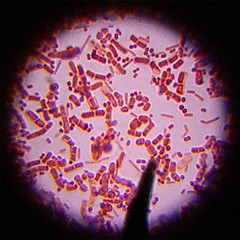
Imagine you want to tour the 10 biggest cities in the UK, starting in London (number 1) and finishing in Bristol (number 10). The solution to the Hamiltonian Path Problem is the the shortest possible route you can take.
This simple problem is surprisingly difficult to solve. There are over 3.5 million possible routes to choose from, and a regular computer must try them out one at a time to find the shortest. Alternatively, a computer made from millions of bacteria can look at every route simultaneously. The biological world also has other advantages. As time goes by, a bacterial computer will actually increase in power as the bacteria reproduce.
Political theatre and sock-puppet ideologies take centre stage on the dusty red plains of Mars, as Blasphemous Geometries examines the latest instalment in the Red Faction franchise.
###
Somewhere, out in the mists of possibility that exist between universes and states of being, there is a game that begins in this fashion :
Your character is sitting in a cramped bedroom in front of a computer. Behind him, on the wall, is the green flag of Hamas (provided by someone down at the mosque, it serves both as a political statement and as a way of covering up an old poster of Ronaldinho. Your character clicks the mouse button and the webcam starts recording. He reads a prepared speech about Gaza and the West Bank and concentrates upon keeping any signs of emotion from his voice. Martyrs, he has been told, must be proud. He has to stop and start again when his voice cracks into an embarrassing squeak on the word ‘Jihad’. He rides his bike to a lock up on the other side of town. A van has been packed with explosives and a primitive trigger that appears to be a wiimote. You snort your amusement at the in-joke. Continue reading Red Faction: Guerilla→
An interesting discussion from Thomas Frey at the DaVinci Institute on at which point our individual identity merges with that of our avatars:
With each generation of avatar, they will become more life-like, growing in realism, pressing the limits of autonomy as we become more and more reliant on them for experiencing the world. The avatar will become an extension of ourselves. The pain that we feel is the same pain that they feel, and vice versa. Like symbiotic twins separated only by a dimension or two, we are destined to become one with our avatars.
Karl Schroeder explores a similar notion of avatars becoming extensions of ourselves in Lady of Mazes.
Chameleon uses gaze-tracking software and camera equipment to track an authorized reader’s eyes to show only that one person the correct text. After a 15-second calibration period in which the software essentially “learns” the viewer’s gaze patterns, anyone looking over that user’s shoulder sees dummy text that randomly and constantly changes.
To tap the broader consumer market, Anderson built a more consumer-friendly version called PrivateEye, which can work with a simple Webcam. The software blurs a user’s monitor when he or she turns away. It also detects other faces in the background, and a small video screen pops up to alert the user that someone is looking at the screen.
Crafty. If the system gets cheap enough, we’ll see internet cafes start to offer private browsing as their unique selling point… although if you’re worried about people seeing what you’re looking at, you probably shouldn’t be doing it in an internet cafe to start with. [via Bruce Schneier; image by Kevin Zollman]
Presenting the fact and fiction of tomorrow since 2001
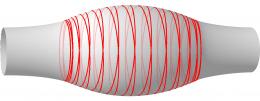 Scientists have developed a technique for confining light within a bottle:
 We’ve seen
 An interesting discussion from Thomas Frey at the DaVinci Institute on at which point our individual identity
 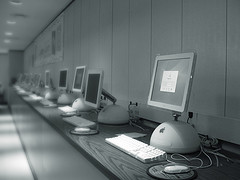 Sick of people shoulder-surfing while you use your computer?