Tag Archives: science fiction

Ken MacLeod explains new novel The Night Sessions

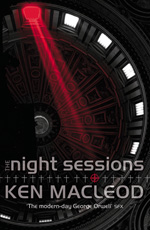
The Night Sessions by Ken MacLeodIf you’re looking for an intelligent contemporary science fiction novel that keeps focused on the near-future, you could do far worse than grab a copy of The Night Sessions, the new book from Ken MacLeod.

There’ll be a review here at Futurismic fairly soon, but in the meantime MacLeod‘s publishers Orbit have a brief blog post where he delivers the “elevator pitch” for The Night Sessions:

The Night Sessions is a crime novel set in 2037. It’s also an SF novel that asks the question: what if we finally got fed up with the influence of religion on politics, education, and law, and decided to drive it out of these areas for good?

They’ve also provided a hefty opening section of The Night Sessions as a free-to-read extract. Go read it, then come back and tell us what you think in the comments.

Hugo Awards 2008 – the winners

Via SF Signal, here are the winners of this year’s Hugo Awards:

  • BEST NOVEL: The Yiddish Policeman’s Union by Michael Chabon (HarperCollins, Fourth Estate)
  • BEST NOVELLA: “All Seated on the Ground” by Connie Willis (Asimov’s Dec. 2007, Subterranean Press)
  • BEST NOVELETTE: “The Merchant and the Alchemist’s Gate” by Ted Chiang (F&SF Sept. 2007)
  • BEST SHORT STORY: “Tideline” by Elizabeth Bear (Asimov’s June 2007)
  • BEST RELATED BOOK: Brave New Words: The Oxford Dictionary of Science Fiction by Jeff Prucher (Oxford University Press)
  • BEST DRAMATIC PRESENTATION, LONG FORM: Stardust Written by Jane Goldman & Matthew Vaughn; based on the novel by Neil Gaiman; directed by Matthew Vaughn (Paramount Pictures)
  • BEST DRAMATIC PRESENTATION, SHORT FORM: Doctor Who “Blink”; written by Stephen Moffat; directed by Hettie Macdonald (BBC)
  • BEST PROFESSIONAL EDITOR, SHORT FORM: Gordon Van Gelder
  • BEST PROFESSIONAL EDITOR, LONG FORM: David G. Hartwell
  • BEST PROFESSIONAL ARTIST: Stephan Martiniere
  • BEST SEMIPROZINE: Locus
  • BEST FANZINE: File 770 edited by Mike Glyer
  • BEST FAN WRITER: John Scalzi
  • BEST FAN ARTIST: Brad Foster
  • JOHN W. CAMPBELL AWARD FOR BEST NEW WRITER: Mary Robinette Kowal

Very few surprises there, I think it’s safe to say. Ted Chiang’s victory was a given long before the nominations were announced, for example; Van Gelder is a shoo-in based on subscriber figures alone, and likewise Scalzi.

The only vague surprise is Chabon taking the Best Novel – not because it’s an undeserving book, as I’m assured it’s excellent, but because its definition as sf has been such a controversial issue elsewhere.

How would you rewrite this list if you had control of sf fandom for the day?

TTA Press launches Transmissions From Beyond podcast site

Transmissions From BeyondTTA Press – publishers of long-running UK science fiction magazine Interzone – have stepped into the podcast arena with the launch of Transmissions From Beyond.

Transmissions From Beyond will republish stories from the TTA stable of magazines, Interzone included, in audio format for you to listen to for free. The first selection includes the excellent Tim Akers story “The Algorithm” – well worth stuffing onto your MP3 player for next week’s commute.

Vicarious WorldCon!

Wishing you were hobnobbing with the great and the good of science fiction at Denvention this weekend? Yeah, me too.

But the wonderful world of the blogosphere means you can experience it at a few removes… among the many people blogging from the scene is Futurismic‘s very own Edward Willett, so pop on over to Hassenpfeffer to see what he’s been up to.

He’s got a photoset going on Flickr, too – I guess missing out on the mammoth queues is one plus point to being stuck at home:

Queuing at Denvention3

Of course, it’s quite possible to find experiencing Worldcons through the medium of blogging to be rather dull and tedious… your mileage may vary. 😉

[Image courtesy Edward Willett – all rights reserved]

The future is not a story

“The future is not a story to entertain you” says Michael Anissimov, back from a long blogging break. He’s tired of people viewing the future through the lens of science fiction, which he sees as being a “baked in” cultural response:

If I were in charge of a futurist seminar, one of the first things I would probably do is discourage anyone from mentioning any fictional story whatsoever. I do believe that fiction does have something to teach us about future possibilities, but the bias towards interesting stories is so overwhelmingly strong that most casual thinking about the future is thoroughly contaminated by it. No narrative can predict the future, because the future is a blur of uncertainties from our perspective, and will only appear like a narrative in retrospect.

I think I can see where Anissimov going with this, but history has demonstrated time and time again that the more you bludgeon people with reasonable rational thinking about what’s to come, the more they screw their fingers into their ears and sing “la-la-la”.

Stories and metaphor may be flawed methods of considering a non-fictional future, but they’re pretty much the only way you can get ordinary people with busy lives to think beyond the next financial year – and I’d contend a flawed method that reaches many people is better than a perfect one that reaches a few hundred.

In other words – don’t blame the tool for the mistakes of the workmen.