
Rushkoff on the economy: “let it die”

restaurant pricing - the credit crunch modelUnsurprisingly, everyone everywhere is talking about the economy. The usual twist on the topic is to ask “how can we fix it?”, but Douglas Rushkoff would like to suggest that the global financial collapse is a blessing in disguise and that we should just let it die, as it gives us a chance to reassess the assumptions that our monetary systems were built upon:

… it’s even more important for us to come to grips with the fact that the system in peril is not a natural one, or even one that we should be attempting to revive and restore. The thing that is dying—the corporatized model of commerce—has not, nor has it ever been, supportive of the real economy. It wasn’t meant to be. And before we start lamenting its demise or, worse, spending good money after bad to resuscitate it, we had better understand what it was for, how it nearly sucked us all dry, and why we should put it out of our misery.

His point is that, at every level, the system was designed to benefit those who set it up at the long-term expense of everyone else – it’s almost miraculous it’s lasted as long as it has:

An economy based on an interest-bearing centralized currency must grow to survive, and this means extracting more, producing more and consuming more. Interest-bearing currency favors the redistribution of wealth from the periphery (the people) to the center (the corporations and their owners). Just sitting on money—capital—is the most assured way of increasing wealth. By the very mechanics of the system, the rich get richer on an absolute and relative basis.

The biggest wealth generator of all was banking itself. By lending money at interest to people and businesses who had no other way to conduct transactions or make investments, banks put themselves at the center of the extraction equation. The longer the economy survived, the more money would have to be borrowed, and the more interest earned by the bank.

Just in case you think Rushkoff’s a sneaky pinko or something, it’s worth considering that he’s an advocate of local economies and currencies, and opposed to any form of centralised control; even if you don’t agree with what he has to say, he raises some talking points that we’d all do well to at least consider. As he points out, we may not get another opportunity… and you know what they say about life handing you lemons. [image by Cory Doctorow]

But what do you think? Should we build a new world where value is produced by actual effort, or can the financial system be fixed to ensure we don’t all strive for the profits of a few?

New low-cost webzine – Alternative Coordinates

Via James at Big Dumb Object comes news of a new science fiction webzine, Alternative Coordinates:

Issue one of new SF magazine Alternative Coordinates is online. The web site looks nice, which has got to be a priority for new webzines. You can read a preview of each story, but full access to the issue costs $2, which I think has to be applauded. The price is low enough to be trivial to many people, yet with volume it means the magazine could make money, probably more than advertising?

Alternative Coordinates - science fiction webzine

James is right, it certainly looks good. The low-price electronic ‘zine model has been tried before, of course, but the economic and techno-cultural landscapes are changing so fast that previous successes and failures are no certain guide to future performance… and if the team behind Alternative Coordinates have made as much of an effort with the magazine itself as they have with the presentation of the website, then US$2 seems a pretty reasonable price to place on six short stories for which the writers have been paid.

If you take the plunge and buy an issue, do pop back and let us know what you think of it!

Edward Willett – Aurora Award finalist!

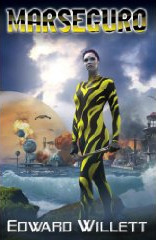
marseguro-edward-willettIt’s a proud day for Futurismicone of our blogging team is a finalist for an Aurora Award!

Edward Willett‘s recent novel Marseguro is one of the five finalists for the Long Form English category of the Prix Aurora Awards, the Canadian Science Fiction and Fantasy Association’s yearly contest. Edward explains:

The Auroras recognize Canadian science fiction and fantasy artwork, writing, and fan activities. Nominated for and voted on by fans, they’re the Canadian equivalent of the Hugo Awards–or, to put it in movie terms, the Canadian science fiction and fantasy equivalent of, say, the People’s Choice Awards.

In other words, it’s about as big a deal for a Canadian genre author as any national award could be, and I’d like to extend my hearty congratulations to Edward on behalf of the rest of the Futurismic team.

You can see all the nominees for all the categories at the Prix Aurora Awards website, but here’s the Long Form English category list in full:

  • After the Fires – Ursula Pflug [Tightrope Books]
  • Identity Theft And Other Stories – Robert J. Sawyer [Red Deer Press]
  • Impossibilia – Douglas Smith [PS Publishing]
  • Defining Diana – Hayden Trenholm [Bundoran Press]
  • Marseguro – Edward Willett [DAW Books]

Congratulations to one and all! Canadian readers of Futurismic, please consider supporting the Auroras by registering to vote – even if Edward’s book isn’t your choice, your involvement will help ensure that this award (and others like it) continues to recognise the hard work of genre authors the world over.

[ Full disclosure: I am a contractor to PS Publishing. ]

Needle-free vaccine

smoothieGood news for spike-averse individuals like myself with the ongoing development of a vaccination method that claims to be as pleasant as drinking a yogurt smoothie:

This new generation vaccine has big benefits beyond eliminating the “Ouch!” factor. Delivering the vaccine to the gut — rather than injecting it into a muscle — harnesses the full power of the body’s primary immune force, which is located in the small intestine.

“Nature isn’t used to seeing antigens injected into a muscle,” said Barrett, who also is a physician at Northwestern Memorial Hospital. “The place where your immune system is designed to encounter and mount a defense against antigens is your gut.”

Wonderful news.

[from Physorg][image from Dannynic on flickr]

Genetically selected babies

dna-manA first for Spain. An earlier version of the story was calling it the first ever, but that can’t be true, can it?

The mother of a child whose life has been saved thanks to the stem cells from the birth of his brother, who was genetically modified to serve such a purpose, has said ‘Andrés is happy.’ The 7 year old boy has now overcome a severe hereditary congenital anaemia, thanks to the blood from Javier Mariscal, his newly born brother.

snip

The couple explained that they had decided not to have another child with the problem, but when the possibility of the Pre-Implantation Genetic Diagnosis arose, they had no doubts, especially as they really wanted another child. Now Andrés will [presumably] have a normal life, instead of living just 35 years, the average for someone with what is now his previous condition.

Wishing the family well, and not wanting to be a Luddite, but readers can probably recite the ethical concerns for themselves.

[DNA Man: tom.arthur]

Presenting the fact and fiction of tomorrow since 2001